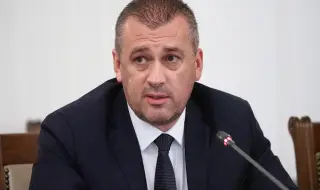
Serious problems in NRIC and BDZ show the initial assessment of the transport sector, said Minister of Transport and Communications Georgi Peev during a briefing in the building of the ministry, at which he presented the leadership team of the ministry and reported on the actions taken in the first 30 days of his administration.
Peev indicated that together with the deputy ministers he had begun work on preparing a clear program with specific deadlines and priorities, after an initial assessment of the state of the sector had been made, BTA reported.
According to him, the Ministry of Transport and Communications is one of the largest departments in the country, with numerous structures, enterprises and companies, and the most serious problems are currently concentrated in the railway sector transport and “Bulgarian Posts“.
The Minister announced that specialized audits have been assigned to the National Company “Railway Infrastructure“ (NCRI), “BDZ - Passenger Transport“, “BDZ - Freight Transport“ and “Bulgarian Posts“. They must be completed within 45 days, after which specific programs for recovery and normalization of work will be prepared.
Regarding NRIC, Peev said that he was surprised both by the scale of the company and the accumulated problems. He noted that in recent years, over 1.07 billion euros have been invested in European projects in the railway infrastructure.
At the same time, the National Railway Infrastructure Corporation administers hundreds of contracts for nearly 2 billion euros, and some of the projects that started in the period 2015-2017 have not yet been completed.
The minister pointed out that commitments for about 765 million euros have been made on European projects without secured financing. He gave examples of contracts related to the safety of the railway infrastructure that have been delayed for years, including for the supply of ballast for the railway.
“For us, it is extremely unacceptable that a safety-related contract cannot be concluded for three years“, said Peev.
According to him, cases have also been identified in which infrastructure projects have been launched without completed expropriation procedures, without the necessary archaeological and geological surveys and without available project readiness. This leads to delays for years, subsequent price increases and the need for additional funds to implement the contracts, the minister explained.
He also announced that advances of over 30 million euros have been paid on projects for which no real construction activities have been carried out to date.
Peev stated that more than half of the railway network in the country operates with temporary or permanent speed restrictions below the design parameters.
According to him, indexations on construction contracts also create problems, as they are paid in a non-transparent manner and without sufficient funds for all contractors.
The minister also commented on the state of BDZ. He announced that a thorough analysis of the need for the existence of the holding structure in the company will be carried out. "I have not heard a single substantial argument to justify the existence of BDZ Holding," said Peev.
According to him, the liabilities of “BDZ - Passenger Transport“ are nearly 30 million euros and create a risk for the implementation of the public service in railway transport.
The minister also drew attention to the poor condition of the rolling stock. He noted that over 300 wagons that continue to be used in the railway network were manufactured decades ago.
Peev warned of a serious risk associated with the maintenance of the Siemens electric multiple unit trains, which perform a significant part of passenger transportation in the country.
He announced that the ministry and the management of BDZ have taken urgent action to provide spare parts and technical maintenance so that there are no serious difficulties in servicing passengers during the summer season.
According to him, contracts have already been concluded for the repair and maintenance of the air conditioning systems of some of the wagons, after problems had arisen in recent years at high temperatures.
The minister also touched on the topic of new trains from manufacturers Skoda and Alstom. He explained that after their delivery, licensing, certification, registration and personnel training procedures will be required, which is why they will not immediately begin work on the railway network.
Peev also emphasized that the state must build the necessary infrastructure to service the new rolling stock, including service bases and specialized maintenance facilities.
With regard to “BDZ - Freight Transport“, the minister stated that the company has liabilities of over 60 million euros, with about 80 percent of them overdue.
According to him, the company is placed in an unequal competitive environment, as it must simultaneously fulfill all the requirements for state-owned companies and compete with private operators.
Peev also warned of a serious risk of losing European funding. He pointed out that under the “Transport Connectivity“ Program, about 80 percent of the funds have been agreed upon as of May, but the actual implementation is approximately 27 percent.
The state of the project for the modernization of the Sofia - Plovdiv railway line is particularly critical. According to preliminary data, the most serious problem is the Elin Pelin - Kostenets section, where additional financing of over 205 million euros is needed.
“We will have to restructure the project and the financing so that we do not lose European funds“, said the minister.