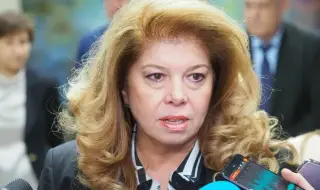
The proposal for sanctions against Patriarch Kirill and Vagit Alekperov caused a very serious discussion in Bulgaria. At the last meeting of the European Council, I did not see such a discussion. We are still working on the 20th package of sanctions. This was stated by the President of the Republic of Bulgaria Iliana Yotova to bTV.
"If we have to find any news, it is the welcome from all European leaders for the fact that the negotiation process for Ukraine's membership in the EU has practically begun, the approval of the intergovernmental conference and the opening of the first cluster. Here the decision of the European leaders was unanimous", she pointed out.
She pointed out that we should speak conditionally about the 21st package of sanctions against Russia, since it may not be adopted at all, "Blitz" pointed out.
Yotova emphasized that she accepts Rumen Radev's arguments to oppose these proposals. "This is not the first time that the name of Patriarch Kirill has been included in and out of various sanctions packages. So far, I have not seen such a discussion in any country. Bulgaria has not participated in these discussions", Yotova explained.
"I am against the fact that when everyone in Europe and when Mr. Zelensky wants to start peace negotiations, Russia should sit at the negotiating table as soon as possible, and we should open a new conflict point. And it will open, at least on the Russian side. We must be convinced of this. Should we now move the debate on whether Europe is against Orthodoxy? Should we divide believers in Bulgaria? My categorical answer is “no“. All our efforts should be directed through diplomatic channels to resolve this conflict“, the president said.
“The war entered every Bulgarian home anyway, because of prices, fuel, because of all the consequences that this conflict brings“, she added.
“When the time comes to discuss this package of sanctions, let's see who exactly proposes it and what the arguments of the proposers are. The exacerbation of this topic and this conflict came precisely from here, from Bulgarian circles“, she said regarding the sanctions against Patriarch Kirill.
“We are an Orthodox country. We want Bulgarian believers not to be divided along these lines, because Orthodoxy is so deeply rooted in our history and has given so much to our history that I would not want a conflict in the country along these lines. I would do everything to avoid it,“ Yotova was categorical.
She agreed with Rumen Radev that this is also about national security, the future of our nuclear power plant, the future of “Lukoil“.
“The more vocal part took up the topic of Patriarch Kirill and it was not at all advantageous for them to comment on the other part of his reasons. In my opinion, this was also done with the aim of drowning out and hiding the good news from the European institutions and this is the next tranche that Bulgaria received under the recovery plan. Which, by the way, two governments failed to do“, the president said.
According to her, in the European institutions, it is always respected when you have your own opinion. “If everyone just did what they did there, the EU would have collapsed long ago. So enough with this policy of ours for 19 years, this yes policy, enough with us behaving like the timid guest in the European family. We have our own policies, interests, we are trying to improve European policies in this way“, she commented on the comparisons between Bulgaria's position now and Hungary under Orban.
“Europe must return to leadership positions and in this regard I am an exceptional devotee of this strategy for strategic autonomy“, she added.
According to her, Europe can no longer be so heavily dependent on NATO in terms of defense.
“If now someone does not realize what a golden card Bulgaria holds in its hands both as a member of the EU and because of its geopolitical position, and because of its geographical position, one day all possible corridors will pass through here – energy, land, related to high technologies, here will be the new data centers, and it will be that secure part of Europe, which will actually be a fundamental element in common European security," the president believes.