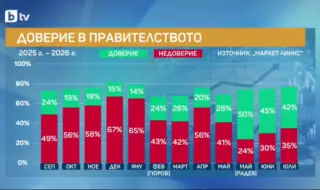
Trust in the government of Rumen Radev continues to decline in the second month of his administration. It has decreased by a total of 8% compared to May, while distrust has increased by 11%.
The data is from a nationally representative survey by "Market Links", conducted jointly with bTV among 1,002 adult Bulgarians in the period July 11-19. The agency's director, Dobromir Zhivkov, commented to the media that this is no longer a momentary reaction, but a sustainable trend, quoted by news.bg
According to him, part of the reasons are in the public reactions to the draft budget and the lack of convincing results on key domestic political issues. "Expectations for this administration were extremely high and it is the inability to meet them that leads to this reaction", explained Zhivkov.
He noted that public attitudes are influenced by contradictory signals on foreign policy issues, such as in the case of the new package of sanctions by the European Union (EU) against Russia, Bulgaria's position on Ukraine and the decision to deploy American aircraft at the "Bezmer" airbase. "It is not a question of whether Bulgaria should be a reliable partner, but how consistent it is in its messages and actions", the sociologist pointed out.
A decline in the personal rating of Prime Minister Rumen Radev is also reported. Dobromir Zhivkov specified that this is natural, since the assessment of the Prime Minister is closely related to that of the work of his government. However, Radev continues to have a significant resource of public trust, although the negative trend is already emerging as sustainable.
At the same time, the National Assembly maintains relatively stable levels of public trust. Zhivkov specified that this is a sign of a gradual restoration of trust in the parliamentary institution after the series of political crises in recent years. "The parliament is going its own way and this is a sign that there is at least a relative restoration of trust in the most important institution in the democratic system", he said.
The sociologist noted that at the end of last year, trust in the previous parliament was only 7%, and distrust - nearly 80%. At the moment, negative assessments are gradually decreasing. Dobromir Zhivkov explained that the current National Assembly is perceived as calmer and more functional compared to previous parliaments, marked by frequent scandals and blockages.
The manager of the "Market Links" agency also said that fewer and fewer Bulgarians share the thesis that the government "is introducing order after chaos". He added that the share of people who believe that the cabinet makes mistakes or does not fulfill its promises is gradually increasing.
Zhivkov also stated that now the public reacts much faster to the actions of the government compared to previous years and already forms its assessments in the first months of a government.
The "Market Links" survey also reports a preponderance of critical assessments of the contract with the Turkish company "Botaş". According to most of the respondents, they believe that the agreement is disadvantageous for Bulgaria. Fewer Bulgarians believe that the contract is good, but its full capacity is not being used. Dobromir Zhivkov pointed out that the contradictory messages of the government on the subject have also influenced public attitudes.