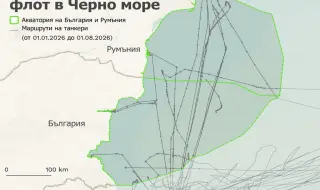
Days after the unprecedented maritime action of „Greenpeace“ – Bulgaria against the abandoned tanker „Kairos“ near Burgas, the organization published a new analysis of the movement of the Russian shadow fleet in the Black Sea. It shows that between January 1 and August 1, 2026, at least 14 tankers from the shadow fleet sailed in the waters of Bulgaria and Romania. The ships spent a total of 418 hours in the waters of the two countries.
The data visualized in a new map of „Greenpeace“ – Bulgaria, are based on the Lloyd's List of shadowy tankers - one of the world's oldest and most authoritative databases on maritime transport and finance. The map tracks which of them have transited the Black Sea. The ships are designated as risky based on behavior such as tampering with or disabling automatic identification systems (AIS), frequent changes of flag or ownership, lack of adequate insurance, and sailing to ports of authoritarian regimes such as Russia, Iran, and Venezuela.
Fossil fuel exports remain a major source of financing for the autocratic regime in Russia and its aggressive war in Ukraine. Oil export revenues for 2025 are estimated at $158 billion and are expected to increase to $191 billion in 2026, according to forecasts by the authoritative research center at the Kiev School of Economics (KSE). The shadow fleet is the backbone of this export: two-thirds of oil exports were carried out by such tankers in June 2026. For comparison, at the beginning of the full-scale war against Ukraine in 2022, Russia relied on shadow tankers for 12% of its oil exports.
“The shadow fleet has long been more than just a tool for circumventing international sanctions. The case of “Kairos“ shows how countries like Bulgaria remain at risk from this illegal scheme. New data shows that this is not an isolated case. Dozens of risky vessels continue to pass through the Black Sea, and some of them spend days in Bulgarian waters. This is simultaneously an environmental problem, a problem for maritime safety and a matter of national security. We do not have a second Black Sea and we cannot allow it to become a corridor for rusty tankers, oil leaks and geopolitical tension“, said Martin Tomov, coordinator of the campaign “Live Black Sea without oil and gas“ of “Greenpeace“ – Bulgaria.
Black Sea - a key route for the Russian shadow fleet
According to CREA data from July 2026, 53% of Russian oil was transported by sanctioned tankers. At the same time, the Black Sea is becoming an increasingly important corridor for Russian oil products from the shadow fleet. According to an analysis by the Kiev School of Economics in April 2026, 41% of the oil products transported by the Russian shadow fleet around the world were loaded at Black Sea ports, and 31% – in the Baltic Sea.
The shadow fleet consists of hundreds of vessels, through which Russia circumvents sanctions imposed after the full-scale invasion of Ukraine and continues to profit from fossil fuel exports. The EU and the G7 have imposed a price cap on Russian oil, but in response, Russia has increasingly started using old tankers with unclear ownership and opaque routes.
No insurance
Many of the ships in the shadow fleet do not have insurance that adequately covers the costs of accidents or oil spills. This means that the damage in the event of a possible environmental disaster, for example in the Bulgarian waters of the Black Sea, will have to be borne by Bulgarian citizens, while the culprit remains difficult to identify.
Another key problem is the manipulation of the AIS (At-sea Tracking Systems). Tankers from the shadow fleet manipulate these systems, significantly increasing the risk of collisions and incidents. According to an analysis by the international organization Follow the Money, 16,000 cases of disappearing AIS signals from vessels associated with Russia have been identified in the Black Sea.
Incidents involving tankers from the shadow fleet have included fires, engine damage, collisions with other vessels, loss of control and spills, according to insurance company data. These incidents often cost governments or insurers of other vessels involved significant costs. They also often involve dangerous transfers of cargo from ship to ship in open waters, which increases the risks of environmental damage manifold. Such incidents have also been documented on the border of Bulgarian territorial waters in a journalistic investigation that has gone unheeded by institutions. At the same time, the cost of cleaning up a potential oil spill from a typical shadow tanker in Europe is estimated at over $800 million, according to a CREA analysis.
The case of the “Kairos“, which was abandoned off the Bulgarian coast after the incident in November 2025, sheds light on the big picture and the many risks that accompany the Russian shadow fleet. In recent months, numerous oil slicks have been recorded around it, and in early August, a team from “Greenpeace“ – Bulgaria documented a leak from it.
The model is no longer limited to oil. Russia is also expanding its shadowy fleet with LNG tankers for transporting liquefied fossil gas. In the past six months, at least eight aging LNG tankers have been purchased that could be used to transport Russian cargo. This comes against the backdrop of an upcoming EU ban on trade in Russian liquefied gas. To conceal the origin of the cargo, the ships are often operated through shell companies or sail under foreign flags. Thus, Russia is building a parallel transport network with which to continue exporting fossil fuels even after the sanctions are tightened.
Risk of military escalation
The Russian shadow fleet is not only smuggling, but also a risk of armed escalation. In June, Greenpeace activists documented the actions of the sanctioned tanker Kira K, which was transporting Russian oil in the German economic zone of the Baltic Sea, together with members of the Bundestag and the European Parliament. Then, a Russian warship, which appeared in the area, took the liberty of approaching the activists' boats and ordering them to move away from the tanker. The action showed that Russia is willing to allow tensions to escalate to protect its illegal network through which it continues to export fossil fuels and finance its military machine.
Separately, an investigation by the “Organized Crime and Corruption Reporting Project“ (OCCRP) found that tankers in the shadow fleet were carrying people associated with Russian security structures, including the private military group “Wagner“ and military intelligence, which monitor the crews and prevent actions leading to the detention or diversion of the ships. There are also serious suspicions that shadow tankers are involved in espionage activities and sabotage operations after the cutting of an undersea cable in the Baltic Sea. The cases show that the shadow fleet also has a military dimension and can create an additional risk to the security of the European countries through whose waters it passes.
The new analysis by „Greenpeace“ – Bulgaria comes days after the organization's action with the participation of the icebreaker Arctic Sunrise near „Kairos“. Activists from Bulgaria, Ukraine, Spain, the United States and the Philippines painted the message NO GAS + OIL on the ship to draw attention to the risks that dependence on fossil fuels poses to the Black Sea, local communities and security in the region. „Greenpeace“ – Bulgaria calls for an end to dependence on oil and gas and for an accelerated transition to clean, renewable and decentralized energy solutions.