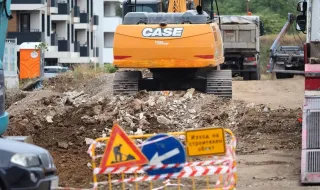
Residents of the capital's "Malinova Dolina" district are preparing a protest due to the lack of sufficiently developed infrastructure. People say that there are no normal roads to some of the new residential buildings, and moving around the area is becoming an ordeal - in the summer because of the dust, and in the winter because of the mud, reports bTV.
The problems are not limited to the streets. Residents point to the lack of sewage systems for wastewater, constant power supply in some of the buildings, transport and a sufficiently developed urban environment with a school and kindergarten.
According to Georgi Krastev, gravel pavement has already been laid on four streets. Two transformers with a capacity of 800 kilowatts have also been delivered, to which some of the buildings are connected. A water supply system has also been built.
„Yes, there is real development“, he admits.
However, the main problems remain.
„We suffer from a lack of sewage for dirty water. We suffer from a lack of permanent electrification in most of the buildings“, Krastev explained.
Among the questions raised by people are also the administrative addresses and lots, as well as the lack of sufficient transport. The residents also insist on a connection between this part of „Malinova dolina“ and the upper part of the neighborhood. Their requests are included in a petition.
One of the owners says that he bought his home five years ago, when there was not a single building on the site yet. According to him, everything existed according to plan, and the expectation was that a new and modern neighborhood would appear here.
“The entire vision of the neighborhood and the promises made by the municipality, investors, and builders were for the construction of a new neighborhood with a modern vision“, he says.
According to him, the idea was “Raspberry Valley“ to become an example of how a new neighborhood can be built while complying with regulatory requirements and the necessary control.
However, the reality, according to those living there, turns out to be different.
„Unfortunately, this good idea and this promise over time has simply become a mirage and you see now what we have to live in“, says the owner.
The man has lived in the neighborhood for two years and describes his daily life as a constant struggle with dust and mud.
According to him, at the intersection of „Todor Nedkov“ and „Atanas Shopov“ streets, two years ago there was partial asphalt, which is almost invisible today.
„We live in constant dust. "Winter is rivers of mud," he says.
After the previous report, measures were taken to ensure that heavy construction machinery washes its tires before entering the Ring Road. However, according to the resident, this led to another problem - the mud from the washing flowed down the street.
"I can't get from my block to the containers without being knee-deep in mud," he says.
The mayor of the "Studentski" district, Petko Goranov, explained the situation with two problems in the legislation. One is related to the possibility of buildings being put into operation without the necessary street infrastructure being built next to them.
According to him, an attempt was made in 2020 to change this by amending the Spatial Planning Act. It was envisaged that a building could not be put into operation if there was no connecting infrastructure.
However, the change did not enter into force after it was appealed and annulled by the Constitutional Court.
The second problem, according to the district mayor, is related to electricity and water. Connection contracts are required for the buildings to be put into operation, but the presence of such a contract does not mean that the connection itself has already been implemented.
„And here is the discrepancy. The presence of a connection contract does not mean a completed connection contract“, explained Goranov.
According to him, it is these “two white spots in the legislation“ that are among the reasons for the situation. The mayor of the “Studentski“ district summarized the process with several factors – fast construction, low prices and insufficient information of buyers.
„Rapid construction, low prices, poor information of buyers and ultimately this is transformed into false expectations and dissatisfaction“, said Petko Goranov.
However, he emphasized that in his opinion „Malinova Dolina“ has a higher degree of infrastructure development compared to other similar neighborhoods.
According to him, over the past two years, the „Studentski“ district, in partnership with private business, has built almost 5,000 meters of streets in the neighborhood, without spending budget funds.
According to the district mayor, „Malinova Dolina“ remains a neighborhood with prospects. He pointed out the proximity to Vitosha and the new extension of the metro, which serves the territory.
“Until two years ago, this was a bare meadow. You can't expect to have infrastructure built in a matter of months. This takes time“, said Goranov.
According to him, the development of the neighborhood must also be in line with the investment opportunities of the Sofia Municipality.
In a written position, the Sofia Municipality states that the construction of buildings is significantly ahead of the development of the neighborhood.
According to the municipality, over 11 million leva have been invested in the construction of three roads, and more projects are being prepared.
For the people of “Malinova Dolina“ however, what has been done so far is not enough.
They continue to insist on normal streets, sewage, electricity, transportation, and an urban environment that is responsive to the rapid growth of the neighborhood.
The dissatisfaction remains, and residents are already preparing for a protest.