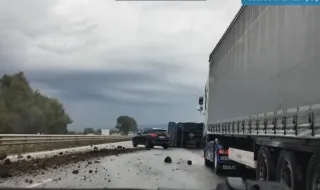
"The proposed bill of "Progressive Bulgaria" is a classic example of a legislative maneuver. The first point in it - the ban on trucks over 12 tons from overtaking in the left lane of highways - is quite consciously used as a "smokescreen". The goal is to raise a media smokescreen, to redirect public attention and emotion to focus solely on heavy goods transport". This is stated in an official position of the Road Safety Institute.
The Institute notes that while the media and society are arguing about trucks, no one is discussing the following paragraphs and clauses, namely where the hidden economic interests are.
"The draft was submitted quietly by members of parliament, not by the Council of Ministers (at the meeting of the Transport Commission it became clear that these were proposals from the Ministry of Interior). This procedure is used quite purposefully:
- To bypass the mandatory public discussion that the executive branch's bills go through;
- To avoid the impact assessment and transparent coordination between institutions;
- To hide the real author of the texts".
According to the IPB, the legitimate question has arisen as to who is actually the author of these proposals and why this cunning legislative shortcut is being used.
"Under the guise of the truck ban, 18 more paragraphs are hidden that have nothing to do with direct safety, but open up huge financial niches for: software for ATCC, ANPR systems and new cameras; huge data sets, servers and cybersecurity; metrological control, service, maintenance and software licenses; laboratory tests and drug tests", the Institute points out.
With municipal cameras, 50% of the revenue from fines is already returned to local budgets - a mechanism that turns road control into a profitable business, rather than a measure to save human lives, the Institute points out.
They insist on answers to the following questions:
1. Who prepared these texts and were there any preliminary meetings with camera manufacturers, software integrators and laboratories?
2. Are there already prepared specifications that can subsequently be turned into public procurement for the "right" companies?
3. Why are new financial mechanisms being sought, since the Road Safety Fund has over 523 million leva (according to data from the National Audit Office), and over 10 million leva of them have been spent on activities with no effect on safety?
The institute is categorical that true reform first requires a proven problem, a risk assessment and a measurable result, not smoke screens to push through public procurement. It calls on Rumen Radev to stop this outrage.