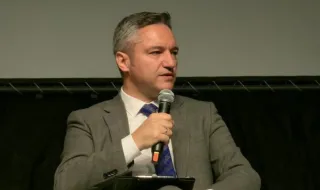
„When a new technology develops without rules, it turns against people. Already, on the other side of the ocean, even China has spoken about the blatant need for regulation. A global commitment is needed to set principles, because artificial intelligence is not something that can be stopped at the border.“ This was stated by Bulgarian MEP Christian Vigenin at the National Forum “Building with Artificial Intelligence: from the Campus to the Smart City“, organized by the University of Architecture, Civil Engineering and Geodesy, in which President Iliana Yotova participated, as well as representatives of institutions, local authorities, business and academia.
Vigenin believes that despite its lagging behind, Europe should not copy foreign models, because they will not work. “The time has come to do much more to encourage the useful applications of AI, for example in traffic management, increasing road safety and detecting the so-called. heat islands in cities“, he gave examples.
According to him, it is the usefulness of these systems that makes the boundary between their normal application and the surveillance of citizens even more important.
“A system can count how many cars pass through an intersection, how many people use a certain stop, or analyze the temperature in different parts of the city. But these same sensors can be used to determine who these people are, where they go, who they meet, and how often they visit a certain place. Here we are no longer talking only about a smart city, but about a change in the relationship between the authorities and citizens“, the MEP explained.
Vigenin recalled that the European Act on Artificial Intelligence regulates various applications according to the risk they pose to people. As an example of the need for balance, he cited the public conversation about more video surveillance after the murder of a young man in Plovdiv. “It is easiest to say: we will install more cameras. But the bigger question is why a group of children and young people have reached such cruelty, what happened to their upbringing, to the family, to the school, to the environment. The camera can record violence, but cameras cannot educate“, Vigenin noted.
The MEP placed special emphasis on personal data. “We cannot become walking data that everyone collects somewhere and then uses at their own discretion. Some say that restrictions on personal data stop progress and innovation, but ultimately we must guarantee rules in which people are protected and technology serves people, and not people serves technology.“
The MEP also commented on the future of professions: “We should not necessarily look at the development of artificial intelligence with fear. There will be new professions, many professions will remain the same, it's just that the requirements for them will be different.“ As a risk, he pointed out the possibility that with the replacement of entry-level positions in a number of professions with artificial intelligence, over time there will not be enough trained specialists capable of exercising real human control over automated systems.
In conclusion, Vigenin emphasized that the qualities of a “smart city“ it is not the cameras, the sensors or the algorithms. “We need to look at the result: are people moving faster, are we wasting less water, are we better prepared for heat waves and floods, are public services more accessible, but are we also managing to preserve the right to privacy of citizens“, he summarized.
For contact with the Group of the Progressive Alliance of Socialists and Democrats in the EP:
https://www.socialistsanddemocrats.eu/