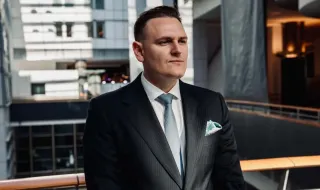
The result of the “Alternative for Germany“ (AfD) in Saxony-Anhalt has put the party in a position where it can no longer be seen solely as a protest force. With 43.8% of the vote, the AfD was only three seats short of an absolute majority in the state parliament (Landtag). Is this a sign of lasting political change in East Germany… MEP Thomas Fröhlich tells FACT.
– Mr. Fröhlich, in the state parliament elections “Alternative for Germany“ (AfD) received 43.8% of the vote in Saxony-Anhalt and was only three seats short of an absolute majority. This is no longer a protest vote, but a clear mandate to govern. Is the AfD really ready to take over the government of a German federal state and what would be the first thing you would change?
– The colleagues in Saxony-Anhalt have clear goals and were elected precisely because of them. Ulrich Sigmund has turned out to be perhaps the most effective politician in Germany in terms of communication. I can only take my hat off to him. So there are several factors here that speak in favor of the AfD's success. And yes, the AfD has long had a mandate to govern in the federal states in eastern Germany. Sooner or later this will happen, I have no doubt about that.
– Federal Chancellor Friedrich Merz reacted extremely sharply and accused the AfD of, through its policy of “remigration“ is striving for “ethnic cleansing“. How do you respond to the Chancellor – is this a political argument, or an attempt to demonize a party that is meanwhile winning over more and more German voters?
– The Federal Chancellor is prone to emotional outbursts.
I don't think I've ever seen another head of government cry so often.
That's why I'm not surprised that, given our electoral successes, he is succumbing to the left-wing moral panic – even though in the 1990s and 2000s he himself used very similar rhetoric critical of migration. However, this is an admission of the failure of the CDU/CSU. Because “remigration“ within the framework of the law, it means deporting foreigners who are obliged to leave the country: criminals, people without the necessary status, those who entered the country illegally, etc. It is also possible to revoke the citizenship of dual citizens who have acquired German citizenship through fraud, and this is legally regulated - and given the mass migration and its consequences, it is urgently necessary.
I cannot understand how the application of the legal instruments of a constitutional state could be equated with forced expulsion. This is radical leftist rhetoric. And it should be assumed that the CDU stands for law and order - and not for left-wing subversion. But apparently that is no longer the case. And this also explains the decline of Christian Democracy in Germany.
– Chancellor Merz says that he sees no point in banning the AfD and that the party must be defeated politically. Is this a change in his attitude towards the AfD, or just another form of political isolation? And is dialogue between the CDU and the AfD possible after this result?
– Merz, as Federal Chancellor, thanks to his advisors and his contacts with the Federal Constitutional Court, certainly knows that a procedure to ban the party that has the highest public support in the entire country cannot succeed.
In the East, the AfD is by far the most popular party.
A third of all Germans would vote for us. East Germany is ready for change, and Saxony-Anhalt is just the beginning. You cannot deprive a third of the population of political rights and declare their demands hostile to the state. At least not if you are a democracy based on the rule of law. It is also quite clear that the AfD's political goals are neither unconstitutional nor extremist in any other sense. I do not think that Chancellor Merz would personally be against banning the AfD. But he has no choice but to continue using the rhetoric of the "firewall" so far. The real challenge in relations with us will be for the next chancellor.
– After every attempt to isolate the AfD, its election results become stronger. Hasn't this political "firewall" become the biggest advertisement for your party in the meantime?
– I cannot deny that the completely disproportionate boycott policy of the other parties has probably contributed to our popularity. They have given up all their political messages and reduced themselves to one anti-identity: they are not the AfD. And in different colors.
Since the country is clearly going downhill under their rule, the public's interest in what is clearly the only alternative in the country is naturally growing. For us, this can only help as a platform. But we also used this platform to present our truly alternative political positions. The election result and the results of the opinion polls speak for themselves.
– What is really behind the election result in Saxony-Anhalt - migration, the economic crisis, high prices, the war in Ukraine or the complete distrust of Friedrich Merz's government?
– Everything. The sad decline of the Federal Republic is multi-layered. At all levels, Germany is mediocre at best. This is largely due to migration policy - it affects healthcare, the welfare state, the real estate market, but also the education system - but not only that. The political elite of this country has completely entrenched itself in an outdated form of global governance and an urban elitism that is detached from reality and has not taken the step towards the 21st century. This is now having its consequences. East Germans in particular did not see much of the promise of the Transition in the end. And that is why they are more than ready for change. Saxony-Anhalt is just the beginning.
– What is the biggest failure of the current government, which turned the AfD into the strongest political force there?
– Saxony-Anhalt is a region with a weak economic structure. The promise of prosperity for all has never been truly realized there. Naturally, the people there feel the consequences particularly strongly when the combination of state overregulation, record tax and social security burdens, deindustrialization and lack of innovation leads to serious social consequences.
It was workers, employees and entrepreneurs who voted for us. These are the people who create economic value, but are squeezed and fear social collapse. This danger is real and affects all Germans - it is simply felt earlier in the East.
– Merz argues that the AfD's position on the EU, the euro and the Schengen area threatens Germany's economic well-being. Do you want Germany to remain in the EU and the eurozone, or do you think that in the long term the country should regain significantly more national sovereignty?
– In the 21st century, independent action by nation states is completely illusory. The other continental countries can still afford it to some extent - the USA, Russia, China, partly Iran or Brazil. But even they depend on cooperation. Germany is the heart of Europe. The continent cannot do without us, and we cannot do without our neighbors - neither economically nor from a security perspective.
Our place is in a European community. In our party, we are happy to argue about the exact form of this community, and that is completely normal. The EU can be useful, but it makes one mistake: it deals with things it should not deal with, but where European policy of unions is important, it fails.
I want a European Union from the right - and not independent action by the Federal Republic outside the European institutions.
– The AfD is pushing for a change in German migration policy, while Merz accuses you of wanting to expel millions of people who work and live in Germany. Where exactly do you draw the line between returning migrants who are staying illegally and a policy that would affect people with a legal residence status?
– The AfD's line on remigration is clear and in line with the law: foreigners who are obliged to leave the country must leave. Period. This applies, among others, to nearly a million Syrians, but sooner or later also to 1.3 million Ukrainians. Criminals too, of course, as well as asylum fraudsters and others. I do not deny that some illegal migrants have become useful for the economy. But this is about the integrity of the state. Whoever confuses labor migration with asylum or illegal immigration weakens the rule of law and destroys the socio-cultural unity of society. For us, this is unacceptable. If under Merz's government the economy depends on illegal migrants, then the problem is probably more in the government's economic policy.
– You are an MEP and are among the AfD politicians who are most critical of the current European model. Do you expect a similar outcome in the elections in Berlin and Mecklenburg-Vorpommern after this result in Saxony-Anhalt? And is it possible that the AfD will become the strongest political force in Germany even before the next parliamentary elections?
– I would rather say that I criticize the politicians of the existing European model, not the model itself. Apart from that, of course, I expect the AfD to achieve further successes. We recently passed the 30% support mark nationwide. For the first time, the CDU/CSU is below 20%. The trend will continue and I am quite confident that in the next parliamentary elections we will be the strongest political force.
– The AfD categorically rejects the continuation of the current German policy towards Ukraine and insists on the restoration of relations with Moscow. If your party were given the opportunity to participate in the government of Germany, would you stop German military and financial support for Ukraine and would you seek a new policy towards Russia?
– We would strive to end this war and to reduce the risk of Germany being drawn into it. And, of course, it is not in the interest of either Germany or Europe that economic relations with Russia remain impossible forever.
At some point this conflict will end - an open war between European NATO and Russia would be collective suicide for both sides. In this sense, we insist on de-escalation, as well as on the cessation of financial payments to Kiev, which are very expensive for us.