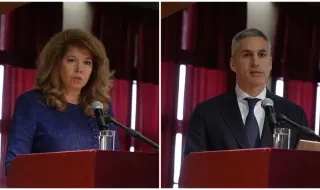
About half of those who decided to vote - 49.2% - are ready to vote for the presidential duo Iliana Yotova-Kiril Valchev.
For their main competitors Andrey Gyurov-Georgi Kandev - 24.8% will vote.
The nationalist vote is concentrated around the candidates of “Vazrazhdane“ Kostadin Kostadinov and Petar Volgin (9.5%) - at a considerable distance from the possibility of reaching a runoff.
Notable in the campaign are the couples Radostin Vassilev-Krasimir Manov (3.1%), Ivelin Mihaylov-Yuliana Mateeva (2.6%) and Ivan Hristanov-Stoyanka Cherkezova (1.9%). However, their presence is reduced to a struggle for prestige.
This is shown by the results of a survey representative of the adult population of the country, conducted by the "SOVA HARIS" Agency in the period October 13-17, 2026 among 1,000 Bulgarian citizens using the method of the standardized face-to-face interview in the respondent's home. Maximum error for a 50% relative share at a 95% confidence level: 3.1%. The study was commissioned by the newspaper “Trud news“.
The fact that the main favorite is a woman should not be ignored, which is an advantage in this turbulent situation both in the country and internationally. The pro-European orientation for the future of our country continues to be leading, the authors of the study comment.
THE LACK OF INTRIGUMENT DECREASES INTEREST IN THE ELECTION COMPETITION
The finale of the presidential election campaign. Sociological data show that the situation is similar to that of the last presidential elections, held in 2021. The declared voter turnout is 38.1%. This level is 2% lower than the turnout in the 2021 elections.
And then the main confrontation was between an incumbent president with center-left views, upholding traditional values, and a competitor standing to the right of center with a liberal orientation.
Read in 5 minutes.
There was no direct debate, discussions on specific policies were in the background, the emphasis in the campaign was on attempts to compromise the opponent on a personal basis. Both then and now, this staging reduced the fight to a test of the hard core of sympathizers of both sides and an inability to attract a peripheral electorate. However, the ratio of support for the two parties is too asymmetrical: those with a center-left orientation are more than twice as many as those with a center-right orientation, the study states.
THERE WILL BE A RUN-OFF
Due to a legal requirement, there will be a run-off. According to the data received, the pairs Iliyana Yotova-Kiril Valchev and Andrey Gyurov-Georgi Kandev will qualify for the second round.
The registered ratio of possible support is 65.8% for Yotova-Valchev versus 34.2% for Gyurov-Kandev, which is very similar to the situation 5 years ago. So far, there is no noticeable trend for a possible change in voters' attitudes. The Yotova-Valchev pair would have an even greater lead over the nationalist candidate pair Kostadinov-Volgin (72.7% versus 27.3%).
The answers to the question “Would you vote for the following candidate-presidential pair“ show attitudes that are not tied to the specific situation and make it possible to determine the amount of maximum support that certain candidates could achieve.
For Yotova-Valchev, this is 29.5% of all voters located on the territory of Bulgaria, for Gyurov-Kandev - 11.7%, for Kostadinov-Volgin - 7.6%. These data mean that the electoral maximum for Yotova-Valchev is about 1.5 million votes. For Gyurov-Kandev - 600,000, and for Kostadinov-Volgin - 400,000. Of course, by the end of the campaign, changes in the choice of voters are possible, but within the outlined parameters. At the moment, there are no indications that any of the candidates can attract a wave beyond the declared support. The fact that the pre-election situation is characterized by the presence of a clear favorite has a negative impact on voter turnout.
THE CURRENT PRESIDENT OF THE COUNTRY BEST MATCHES THE ELECTOR'S EXPECTATIONS
Regarding Bulgaria's position in Europe, the largest share of people (47.7%) support an approach based on loyalty to European partners, but also on defending national interests. At the same time, 36.4% prefer the country to be guided solely by its own interests, while only 10.5% believe that Bulgaria should follow the decisions of European institutions. This distribution shows a clear preference for independent determination of national policy, without rejecting European cooperation.
With regard to the presidential institution, the expectation that it will play the role of a corrective (49.8%), rather than a balancer (37.7%). This suggests a search for more active institutional control and the ability to counteract management decisions that are perceived as problematic. The result can also be interpreted as an indication of dissatisfaction with the functioning of other political institutions.
Assessments of the reasons for the rise in prices in our country also reveal a critical attitude towards domestic governance.
Almost half (47.5%) point to domestic political factors as the main reason, with 37.2% emphasizing foreign policy circumstances. This shows that a significant part of society is looking for an explanation for the rise in prices primarily in domestic economic and political processes. These results reflect public perceptions, and do not prove the objective relative contribution of different factors to inflation.
Attitudes towards the upcoming elections are more ambiguous. While 45.2% expect the government to ensure conditions for a fair and democratic vote, 24% do not share this opinion, and 30.8% cannot judge.
The significant share of those who hesitate, together with a quarter of adult Bulgarians expressing distrust, shows that confidence in the guarantees of a fair electoral process is not categorical.
Positive expectations are the most widespread individual position, but do not form an absolute majority. Compared to the pre-election situation in April 2026, the share of people who believe that the government will succeed in ensuring conditions for fair and democratic elections is now 10% higher. This shows that the country is undergoing a process of stabilization of the attitude towards the executive branch.
In summary, the survey outlines a society with a pronounced desire to protect national interests, expectations for the presidential institution to exercise control and a tendency to seek domestic political responsibility for economic difficulties.
In addition, the results of the upcoming elections show the presence of uncertainty and a deficit of unconditional trust. The general profile is of a society that does not reject the institutional and European model, but expects a more convincing defense of its interests and greater accountability from those in power.
The data are from a representative survey of the adult population of the country, conducted by the SOVA HARRIS Agency in the period October 13-17, 2026 among 1,000 Bulgarian citizens using the standardized face-to-face interview method in the respondent's home. Maximum error for a 50% relative share at a 95% confidence level: 3.1%. The research was commissioned by the newspaper “Trud news“.