“A clash of different trends. It seems that the biggest challenge will not be to predict who will be the winner of the first round of the presidential elections - this is clear, but what the voter turnout will be.“ This was commented on “This Morning“ Dobromir Zhivkov, a sociologist from "Market Links" regarding data for the upcoming presidential elections.
His analysis is based on data from a National Survey, jointly funded and implemented by bTV and “Market LINKS”, conducted among 1006 people over 18 in the country in the period October 13 - 19, 2026 using the methods of direct-personal interview and online survey.
“The presidential elections in general do not arouse such serious interest, especially after this, I would say, peak of voter turnout that we had in April. Now the tone of the Bulgarian voter is definitely lower, but, on the other hand, we are observing signals that activate Bulgarian citizens“, he pointed out.
In his words, one of the topics that categorically politicizes society and makes almost every individual citizen take a position is the escalation in the Black Sea.
“We will not be surprised if this politicization leads to a slightly higher voter turnout than expected or even to a turnout slightly higher than that in November 2021, when it was 40%. So these are different trends. On the other hand, we must emphasize that what also negatively affects voter turnout is the general feeling about the development of the country. That is, the assessment that the state is not developing in the right direction also demobilizes citizens from participating“, commented Dobromir Zhivkov.
The voter turnout is expected to be 39%, which means a sure runoff.
“Here, however, the limits could be 2-3 percentage points down or up, depending on how the last week develops. This survey ended on Monday at noon and the data is as of this moment. There is still almost a whole week“, commented the sociologist and specified that a large part of the voters — between 15% and 20%, make a decision in the last two days. “Of course, when we are in a survey situation, we are much more inclined to say that we will go and vote, but this does not always happen“, he also noted.
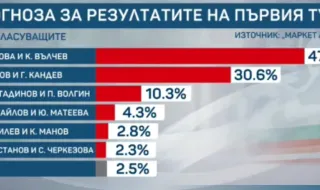
The results of the survey show a clear winner — the pair Yotova–Vulchev with 47.3%.
Gyurov and Kandev are in second place with 30.6%
Kostadinov and Volgin are in third place with 10.3%
Mikhailov and Mateeva — 4.3%
Vasilev and Manov — 2.8%,
Khristanov and Cherkezova — 2.3%
„The rest should be below 1%, at least according to the data we have at the moment. And we say that this is a forecast. That is, here we have tried to take into account both the vote from abroad and the factors that influence it, including, of course, the party sympathies of those Bulgarians who vote outside Bulgaria. There we also expect lower voter turnout. And in fact, these are the results we are seeing at the moment“, commented Dobromir Zhivkov.
“We must say that there are specifics in the electorates of the first two pairs. 75% of the voters of Yotova–Vulchev are actually voters of “Progressive Bulgaria“ in April“, he noted.
According to him, the remaining 25% are diverse.
“There is a significant part of them who actually say that they did not vote. That is, there are also newly attracted voters. While with Gyurov and Kandev things seem even more colorful, because with them there is participation of both GERB voters and MRF voters, as well as those who did not vote. But the core, we must say, of course, is “We continue the change – Democratic Bulgaria“, Zhivkov pointed out.
Kostadinov and Volgin are attracting disappointed Russophiles who expected a different, more categorical position from Radev regarding Russia.
“This is the reserve for this vote, which we see as a majority specifically for the two candidates. We must say that it is significantly higher than the support that “Vazrazhdane“ currently has at the parliamentary level“, the sociologist pointed out.
“Even in the current results, it remains at this level, which is interesting because it really speaks of a strong majority element in their candidacy“, he also noted.
Mobilization for early voting
“If we now have an extraordinary parliamentary vote, in first place continues to be “Progressive Bulgaria“ with a serious lead, but we must say that here we still have between 2 and 3 points down. That is, the result for another month since the beginning of the government of this cabinet is going down and this is again visible in all the indicators that we measure“, pointed out Dobromir Zhivkov.
“There is also a shift - GERB is no longer the second political force, although here we must say that the result is practically the same and in the elections literally on Sunday it could be the other way around. But we must say that “We continue the change“, like Kostadinov and Volgin and “Vazrazhdane“, is gradually starting to attract those who drop out of “Progressive Bulgaria“ and this is very clearly expressed in this result and this, at least symbolically, second place for now“, he commented.
10.2% for „We continue the change“
GERB with 9.6%“
About 7% are „Democratic Bulgaria“.
Down are „Vazrazhdane“ and DPS“
In „Mobilization for the early vote“ the topics related to current events and the attacks in the Black Sea“ are emerging in society regarding national security.
„A very serious anxiety is emerging in society regarding national security. 68% believe that these are truly significant, serious threats, while only 15% tend to downplay them, and 17% are neutral.
68% say that the attacks are a threat to national security, and according to 15%, the attacks are not a threat and are actually being overexposed“, commented Dobromir Zhivkov.
“Society has a relatively clear position on who is behind these attacks. 43% believe that this is the work of Russia, 28% believe that they are attacks initiated by Ukraine itself, and 29% cannot determine“, he pointed out.
According to him, we are once again beginning to wonder to what extent the political class, and the government, of course, are managing to properly address this problem.
“Bulgaria is the last to give a clear answer. We see that the European institutions have already made it clear enough. The intelligence services of our partners also gave it“, the sociologist pointed out.
Trust in the government
“Trust in the government is also on a downward trend. It seems that this trend is already starting to reach a plateau. Because we see, although a decrease in trust and a very small increase in distrust, we still have to say that the cabinet is already more distrusted than trusted. 41% declare distrust against 36% trust now in October, with the difference in the net rating already being about 4 percentage points down compared to the previous month“, pointed out Dobromir Zhivkov.
“The picture is repeated in the ratings of political leaders. Rumen Radev now has practically equal trust and distrust. We have an increase in trust in Assen Vassilev with more active criticism, which is obviously heard more clearly by that part of the voters who support the political force led by him. We said last month that we noted an increase in trust in Kostadin Kostadinov, despite the high levels of distrust that we see in the second, third and fourth in this peculiar ranking. 16% trust against 70% distrust in Kostadin Kostadinov. But we say again that here his majority potential significantly exceeds the party support of “Vazrazhdane“. And this is a specific result that must be taken into account“, commented the sociologist.
“Mr. Borisov is now sustainably below 15% — in this case 12% trust and 79% distrust. Things here already seem to be sustainably structured in this way. Ivaylo Mirchev — 11% trust and 64% distrust. And Bozhidar Bozanov, the other co-chairman of “Democratic Bulgaria“ — with 10% trust and 64% distrust. Mr. Kanev, who is the chairman of DSB — with 8% trust and 58% distrust. And Mr. Peevski — with 6% trust and 91% distrust, traditionally remaining in last place in this peculiar ranking of political leaders“, he also pointed out.
Trust in the National Assembly
“Distrust is growing. The general picture so far: 18% of society retains trust, declares trust in the parliament. But from 58% in September we now have 64% distrust. That is, again a devaluation of trust in basic institutions. We see both the cabinet, we see also the parliament, in which “Progressive Bulgaria“ has a majority. In fact, they show one common assessment. And let's say in conclusion that it is largely due to the economic results that are currently visible, and the prices“, the sociologist commented.
“Prices worry people. The reasons are economic to a very large extent. This is the leading one, but the threats are starting to become a very constant background of tension in society, which is also, of course, starting to shape attitudes. And it will determine to a large extent, in my opinion, the direction of the vote, because the geopolitical division is starting to have its say in this campaign“, commented Dobromir Zhivkov.
The national survey, jointly funded and implemented by BTV and Market LINKS, was conducted among 1,006 individuals over 18 years of age in the country between October 13 and 19, 2026, using the methods of direct personal interviews and online surveys.