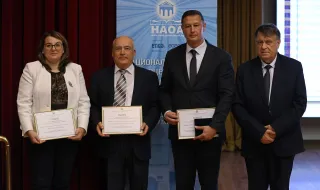
Higher schools must continue to be the pillars of fundamental scientific research, but at the same time it is necessary to seek more opportunities for real partnership with business. This was emphasized by the Minister of Education and Science, Prof. Georgi Valchev, during the ceremony for presenting the annual awards of the National Agency for Evaluation and Accreditation (NEAA) for good practices “Science – higher education – business and society“.
Minister Valchev congratulated the leadership of NEAA for the initiative, which encourages cooperation between the academic community and the real economy and gives publicity to successful examples in this area “Funding is extremely important, but we must also show everything you achieve. This is done precisely through such initiatives that promote good practices and real results from scientific and educational activities“, the minister pointed out.
In his words, Bulgaria has successfully entered the modern European and global academic space and has a number of achievements that deserve to be shown. This is important both for public support for higher education and science, and for the trust of young people who choose to continue their education at Bulgarian universities.
The President of the NEAA, Prof. Dr. Maria Nisheva-Pavlova, emphasized that the initiative is not only an opportunity to recognize the achieved results, but also to share successful solutions that can be applied in other higher education institutions and scientific organizations. According to her, good practices show how cooperation between the academic community, business and society can lead to concrete and sustainable results.
She also highlighted the creation of a Catalog of Good Practices of the NEAA, through which successful partnership models will receive wider publicity. The aim is to encourage the exchange of experience, the implementation of innovations in education and the closer linking of academic training with the needs of society.
Minister Valchev presented the first prize in the category “Implementation of scientific results for the benefit of business/society“ to the University of Economics – Varna for the project “CaLV – Decision Platform – Integrated digital environment for economic analysis and optimization of production decisions at the animal and farm level“.
The second place in the category was awarded to the National Center for Infectious and Parasitic Diseases for a practice related to the assessment of genomic stability of production strains in biotechnological production. The Technical University – Varna was awarded third place with the initiative “Learning through experience in “Living laboratories“ in restorative agriculture and agroecosystem management“.
The second edition of the NEAA initiative involves 16 higher education institutions and two scientific organizations, presenting a total of 58 good practices. The awards are awarded in six categories, covering the partnership between universities and businesses, the implementation of scientific results, lifelong learning, socially significant initiatives, the engagement of students and young scientists and the sustainable development of higher education institutions.
The presented initiatives were evaluated by the Advisory Council of the NEAA, on whose initiative the ceremony is also held. Among the main criteria are public significance, innovation, sustainability and the participation of business and students.
The host of the ceremony - the rector of the University of National and World Economy, Prof. Dimitar Dimitrov, highlighted the importance of the assessment that business and society give to the quality of higher education and the preparation of students.
The ceremony was held in the “Maxima” auditorium of the UNWE in the presence of rectors, representatives of the academic and scientific community, employer organizations and the National Representation of Student Councils.