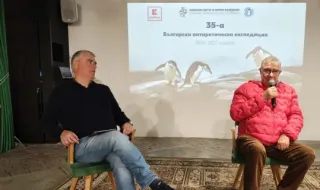
Over 35 scientific projects, the first Bulgarian study in the field of underwater archaeology, studies of ocean currents, monitoring of the polar environment and a pilot project on the concentration and transboundary transport of radon are among the tasks of the 35th Bulgarian Antarctic Expedition. This season, the research vessel “St. St. Cyril and Methodius“ (NIK 421) will be used to an even greater extent as an independent scientific platform. It is planned to implement 12 projects on board.
Among the most interesting initiatives is the project in cooperation with the Institute of Underwater Archaeology, which will use the ship to begin research on the underwater heritage in the area of the South Shetland Islands archipelago. Another project, carried out jointly with German scientists, will study the physical and chemical processes of ocean currents in the straits around the islands.
Interdisciplinary observations of the components of the polar environment will also continue, and the collected data will be entered into specialized databases. A project by a young scientist from the Faculty of Physics of Sofia University is also planned, dedicated to the concentrations and transboundary transport of the radioactive element radon.
The new scientific laboratory block is to be equipped with freezers, coolers and microscopes at the base itself. A new marine laboratory will also be put into operation, and geologists and glaciologists will work in three field camps at different locations on Livingston Island and, if conditions permit, on Smith Island. Among the infrastructure tasks are the completion of the cable network, which should allow the base to operate over 60% of the time with renewable sources, the improvement of the water supply and the final completion of the new treatment plant.
The ship sails on November 4 and heads to COP31
NIK 421 “St. St. Cyril and Methodius“ will sail from the Varna Sea Station at 11:00 on November 4 for its fifth mission to Livingstone Island. The entire voyage is planned to last 162 days. Before heading to South America and Antarctica, the ship will make a stop in Antalya, where the 31st Conference of the Parties to the United Nations Framework Convention on Climate Change – COP31 is taking place from November 9 to 20. After Antalya, the route continues with stops in Brazil and Mar del Plata, Argentina.
The first scientists who will continue by ship to Antarctica should board in Punta Arenas on December 26, and their arrival at the Bulgarian base is expected on December 31 or January 1. The base “St. Kliment Ohridski“ will be opened in mid-November and will operate until mid-March. The participants will travel in seven groups, and in addition to the Bulgarian ship, the Spanish “Sarmiento de Gamboa“ and “Hesperides“ will be used, as well as flights by the air forces of Chile, Colombia and Brazil.
The expedition is also shaping up to be even more numerous than the previous one. According to Dragomir Mateev, deputy director of the National Center for Polar Research and head of logistics in the Antarctic program, last season over 75 people passed through the base, while this year around 90 are expected.
„Last year, the workload of the base and the ship reached a kind of record. We had over 75 people working at the base, over 28 projects that were implemented. This year, the plans and things that we are currently planning show that all these numbers will increase. The expectations for visits to the base will be around 90 people during the season. The projects will be over 35“, said Mateev.
During the busiest periods, between 35 and 40 people will stay at the base at the same time - practically its maximum current capacity. The own ship allows participants to be distributed more evenly throughout the season and, accordingly, more scientific projects to be implemented.
The Bulgarian base attracts more and more international teams
According to Dr. Rositsa Yaneva – head of the “Science“ department at the National Center for Polar Research (at the Sofia University “St. Kliment Ohridski“), the conditions for scientific work on Livingston Island are constantly improving, and the new laboratory block significantly expands the opportunities for scientists.
„Current working conditions at the Bulgarian Antarctic base are more than good. It is constantly moving towards improvement, expansion, wonderful new opportunities. In the new laboratory block, which was completed, the biology, geology and general laboratory laboratories are to be equipped“.
The increase in capacity goes hand in hand with the expansion of international scientific cooperation „Over the years, the capacity of the base has been gradually increasing. Scientific projects are increasing. From projects that were currently in the direction of one discipline, multidisciplinary projects with international teams are now being developed. New partnerships are being created. Scientists from Greece, Romania, Montenegro, Turkey, and the United Arab Emirates are already traditionally working at the base. This year there will also be from China, from Colombia, Ecuador, Portugal“.
The research ship is also no longer seen only as a transport for people, equipment and supplies. The enlarged research ship is now being used to its full capacity. Not only to transport products, cargo and people, but it is a working platform for scientific research.