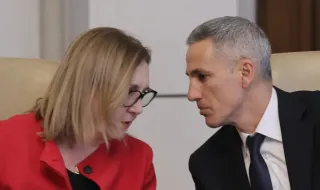
Support for Andrey Gyurov in the presidential runoff must find political expression, Rumyana Buchvarova said on Bulgaria ON AIR. According to the final results, the candidate and his vice-presidential running mate Georgi Kandev received 750,251 votes, or 39.48% of the vote. Iliyana Iotova won the election with 1,093,852 votes and 57.57%.
Buchvarova, who was part of Gyurov’s team during the campaign, said that his future depends on his own decision.
“He will make his own decision on how to proceed. He is becoming a nationally recognized figure who represents certain positions. In the near future, he should remain in this position,” she said.In her words, protest energy has concentrated around those who supported Gyurov. She described the voters of the two right-wing democratic parties in parliament – We Continue the Change and Democratic Bulgaria – as its core.
Is a new unification on the right possible
According to Buchvarova, new cooperation in the right-wing political space is necessary, rather than a repetition of the old political models. She described the cooperation between We Continue the Change and Democratic Bulgaria during the presidential campaign as positive and suggested that it could continue.
However, the sociologist does not expect national party relations necessarily to be replicated at the local level. In her words, local coalitions are often more attractive to voters.
“The unification of parties is only one of the possibilities for their cooperation in pursuing their goal,” Buchvarova said.She pointed out that there must be clear rules governing relations between the formations, as well as efforts to attract broader public support.
Mobilization in the runoff
Buchvarova explained the difference between the results of the first and second rounds by the mobilization of voters supporting Iliyana Iotova. According to her, more people who had not participated actively in the first round voted in the runoff.
She also allowed for the possibility of corporate and paid voting becoming more active, but stressed that she had no information about specific arrangements. Buchvarova attributed the discrepancy between the exit polls and the final results to full mobilization at the end of election day.