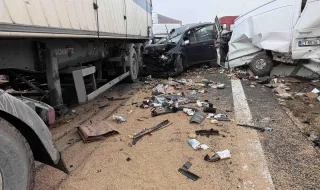
Cameras operated by the Road Infrastructure Agency showed in real time how the fog began to thicken on the section of the Trakia motorway where the serious chain-reaction crash later occurred. Georgi Galabov of the Institute for Road Safety said this on NOVA NEWS’s “Social Network” programme.
According to him, around two hours before the incident, an interactive system had sent a warning that weather conditions were expected to deteriorate precisely in that area. Galabov pointed out that the system had been developed for preventive purposes, and that the warning had been received by an institution that could have taken action.
“Even the Road Infrastructure Agency’s cameras recorded the situation around two hours before the event and showed in real time that the fog was beginning to descend,” Georgi Galabov said.He recalled that the interactive map had been presented in July and allowed real-time monitoring of average-speed violations. According to him, the cameras provided information not only about the weather conditions, but also about drivers travelling at high speed in conditions of severely restricted visibility.
Galabov: Preventive measures could have been taken
Georgi Galabov said that the fog should not be viewed as a sudden circumstance for which the state had lacked the necessary technology and resources. He pointed out that in such a situation, the first measure should be to treat the road surface in order to limit the risk of black ice forming.
As another possibility, he mentioned gradually restricting traffic or temporarily stopping it in the dangerous section.
“It would be better for no one to travel for 2–3 hours, or for traffic to operate at severely reduced capacity, than for this to happen,” Galabov stressed.According to him, the availability of information about the thickening fog also raised the question of why a patrol had not been sent to the scene. “It is not logical for some kind of patrol not to have been sent; they had been observing for several hours that the fog was descending,” he said.
Galabov did not identify a specific institution that he believed was responsible for the measures not being taken. However, he said that the presence of cameras and monitoring systems had made it possible to detect the dangerous change in conditions in advance.
Sources: nova.bg, bnrnews.bg