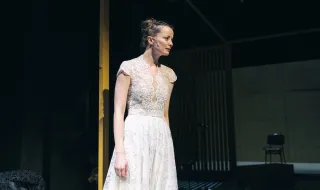
Henrik Ibsen’s play „Nora“, staged at the Ivan Vazov National Theatre, raises questions about women’s independence, personal freedom and equality that remain painfully relevant today. In the production by Macedonian director Nela Vitoshevic, Slovenian actress Aida Smrekar creates the image of a woman who dares to oppose social norms and seek her own identity. Here is what Aida Smrekar told FAKTI.
- Ms Smrekar, „Nora“ is one of the most recognisable female characters in world drama. How did you develop your interpretation of this heroine, and what about Nora’s story moved or made you think the most?
- The first association we make when we think of Ibsen’s „Nora“ is that it is the play in which a woman leaves her husband and children. Yet no one asks why it came to that and what circumstances led her to take this extreme step.
It is a complex character who taught me many things. Above all, how important it is to listen to yourself, to act in accordance with the values and beliefs you carry within you, and to take responsibility for your actions.
We live in a world where opinions have never before been imposed so aggressively. It is easy to get lost in the stream of all kinds of news. We judge very quickly. A few rumours and headlines read online are enough for us to form an opinion. And then what we like most is to argue, armed with this scant knowledge. We are no longer able to listen to ourselves without being influenced by someone else’s opinion.
That is precisely what happened to Nora, who had to live by rules first determined by her father and then by her husband. Although it is true that men are to blame for many things, we must not forget the system, the male world.
Ibsen’s play is extremely relevant because we can recognise ourselves in it.
We still live in a patriarchal world, but we all bear responsibility for this – both men and women. Feminism is not solely a women’s cause either.
International Women’s Day is not a holiday on which we are placated with a flower so that we keep quiet, but a reminder to both sexes that we must share the burdens, responsibilities and beauty of life. A man is not a woman’s support if she has to constantly remind him to fight for her rights. We must move towards one another, rather than constantly showing each other the middle finger.
- Nora makes the radical decision to leave her husband and children in order to seek her own identity. How do you understand her choice, and do you think it can be justified from today’s perspective?
- The twentieth century is full of Noras. I will mention only Marilyn Monroe and Lady Di. I am convinced that we can find such women everywhere, including among people like you and me.
Yes, this is the story of a strong woman who initially devotes all her efforts to what she considers the common good – unconditional love, the family’s wellbeing and happiness.
When she realises that everything she does is part of a stereotypical social role serving solely to maintain an outward image, she feels betrayed and humiliated. When she understands that reciprocity in the marriage existed only in her imagination, she feels that change is possible only through a radical break, which requires a sacrifice from her as well.
This requires inner strength and, above all, the courage to reject the easier solutions and accept society’s condemnation. Alone against society, she has no choice but to shatter its taboos through her personal example. This becomes her mission.
- Henrik Ibsen’s play was written in the nineteenth century, yet the themes of women’s independence, marriage and personal freedom remain relevant. Why does society continue to grapple with these questions?
- It is true that women have more freedoms and rights today. At the very least, we have the right to vote, which women at the end of the nineteenth century did not have. But patriarchy constantly changes its forms within society.
I believe this is mainly due to social expectations and norms that are still deeply rooted in us.
Violence against women, the #MeToo movement and similar contemporary social phenomena remind us that 140 years have passed too quickly, while throughout all that time we have been treading water.
- How did your work with Macedonian director Nela Vitoshevic unfold? What new element did her interpretation bring to the familiar character of Nora?
- Nela and I were a perfect match; otherwise there would have been no production at all. Nela is not only a phenomenal director but also a wonderful person with a big heart, always open to communication and different opinions.
I admit that I was happy that „Nora“ was being directed by a woman. It seems to me that a male director might have emphasised extreme situations, intensified conflicts and heightened emotionality – perhaps even because of his own discomfort. We women deal with such things with the help of the Moon, which raises and lowers the water in long, lingering waves.
During the table work, it occasionally became clear how differently we understood certain situations, although in my view actors are one of the most open professional communities. Everyone had identified so deeply with their character that the conflicts in the dialogues became completely real and genuine, placing us here and now.
For two months we worked with a director who does not speak Slovenian. We communicated in all kinds of languages – Serbian, English, German, with gestures... We mixed all kinds of languages and laughed a lot about it. Perhaps this is precisely where the secret lies of the emotional immediacy and rawness with which the team subsequently won over the audience.
The fact is that when you work with a text in which the nuances of the words in the sparingly written lines are extremely important, you inevitably ask yourself how you will overcome the language barrier.
Nela surprised us all with her precision regarding the words and ideas, with how well she knew the text from beginning to end, how fluently she mastered the Slovenian lines and how carefully she considered the meaning of every sentence and every word within the context of the production’s dramatic development. She focused on which emotional experiences we needed to bring to the fore in order to turn them into a convincing portrayal of the relationships between us. We worked extensively on this.
- To what extent is Nora a victim of circumstances, and to what extent does she herself participate in creating the world from which she ultimately decides to escape?
- Nora undergoes an incredible transformation. From the ideal woman according to patriarchal notions, who pleases her husband in every respect and takes care of his public image by raising the children and constantly obeying all the rules so that society will see her as the ideal partner, she becomes a woman rejected by society, ready to do something unthinkable in the eyes of bourgeois society.
When she loses faith in reciprocity within the marriage, she leaves her husband and children in order to save herself. In the end, she realises that she has never known any other way of life. From her father’s hands, where she had to conform to all his opinions and expectations, she went straight into her husband’s hands, submitting to his values and understanding of life.
This realisation brings her to a turning point at which she begins to suffocate, because maintaining such an image requires self-denial, double standards, pretence, concealment and lies.
Behind the beautiful image of the respectable woman and wife lie the most undignified feelings, calculation and self-interest. None of this is discussed. Because it is improper!
Nora cannot bear the weight of this realisation, and in the end what happens, happens.
But the true turning point for her comes when she understands that her husband sees her solely as a function, that he does not even see her as a human being. To him, she is simply a housewife and the mother of his children.
Torvald’s situation is not enviable either, because he himself is incapable of stepping back and seeing the whole picture. He is blindly convinced that his main mission is to provide the family’s material existence and social standing, while the people he supports should reward him by creating the image of a harmonious, happy and successful family.
Love has no significance here.
It is love that makes Nora violate the social norm. She finds a solution that Torvald himself is incapable of finding. In this way she saves the life of the man she loves and ensures the family’s survival and wellbeing, while he blindly insists on adhering to social norms.
He himself would allow himself to be buried as a martyr without even thinking about the fate of a single mother with three children.
The realisation that her love is not reciprocated makes Nora break the taboo.
In fact, Nora does not save only herself. Her rebellion is not directed against her husband and his insensitivity. Nora opposes the system, society. She becomes an activist who demands what we today call human rights – including women’s rights.
She leaves and slams the door behind her.
- Does genuine equality between women and men exist today in society and professional life, or are women still expected to adapt to predetermined roles?
- As long as we continue talking about quotas for women, we have not achieved all that much, because this is a sign that equality exists only on paper.
The way of thinking that is deeply rooted in history and entrenched in social norms must change, and we women also bear responsibility for that.
Change requires patience and time.
Above all, we live in times when everything suggests that we are moving backwards in history, repeating old patterns, and every struggle – not only for women’s rights, but also for basic human rights – is becoming even more important!
- How does an actor change when repeatedly portraying the same character? Do you discover new sides of Nora with each subsequent performance?
- Without a doubt. And what magic it is! With every performance, Nora grows and develops alongside me.
- What is the greatest challenge facing contemporary theatre – preserving classical works or reinterpreting them through the lens of the problems of today’s society?
- The greatest challenge is to preserve the classical text in its original form and reinterpret the somewhat dated dialogues in places so that contemporary audiences can recognise themselves in them. With „Nora“, we constantly drew comparisons with contemporary society and looked for parallels, which was not even particularly difficult. We sought to preserve the production in as classical a form as possible, while at the same time bringing it as close as possible to the present. The subject itself gave us this opportunity.
The production is stylised, with Scandinavian minimalism, and the action unfolds in a timeless world.
We hoped that it would be precisely through the relationships and conflicts between the characters that we would manage to bring the story closer to the contemporary audience.
- What would you like Bulgarian audiences to take away with them after encountering your Nora? Is there a question you hope the production will leave in their minds long after it ends?
- Nora is a heroine of modernism. The entire twentieth century is dotted with Noras, and there will be no shortage of them in the twenty-first century either. In the intellectual horizon of the Western world, her departure and the breaking of the taboo of bourgeois society mark the arrival of the modern era.
Nora reminds us that women’s rights and, in a broader sense, human rights are not given to us once and for all; we must fight for them at every moment, again and again. This is a message not only to Bulgarian audiences, but to all audiences – today and tomorrow.
--------------------------------
Aida Smrekar was born on 24 March 1985 in Novo Mesto, Slovenia. She graduated in communication studies from the University of Ljubljana in 2011. At the same time, she studied acting at the Academy of Theatre, Radio, Film and Television (AGRFT), graduating in 2013. In 2015, she completed a master’s degree in dramatic arts. Since 1 September 2013, she has been a member of the ensemble of the Ljubljana City Theatre (MGL).
She has appeared in the films:
„Road to Paradise“ (Pot v raj, 2014);
„Idila“ (Idila, 2015);
„Gaja’s World“ (Gajin svet, 2018);
„Kapa“ (Kapa, 2022);
„Gaja’s World 2“ (2022).
Her accolades include:
2025 – Stane Sever Award for her achievements in professional theatre.
2023 – Župančič Award for her work over a two-year period.
2021 – Veliki plan Award for her acting achievements.
2014 – Stop Award for Actress of the Year for her role in the film „Road to Paradise“.
2012 – Stane Sever Student Award for her role in „Julius Caesar“.