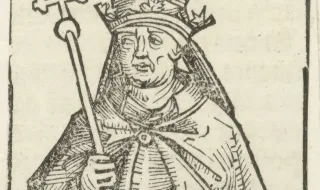
One hundred and fifteen questions sent by Prince Boris I to Rome turned the Christianization of Bulgaria into one of the major ecclesiastical and political issues of the 9th century. On November 13, 866, the Bulgarian envoys received Pope Nicholas I’s answers, which went down in history as “The Answers of Pope Nicholas I to the Questions of the Bulgarians.”
The delegation arrived in Rome on August 29 of the same year. The prince’s questions concerned not only the foundations of the Christian faith, but also the everyday life of the newly baptized society. Boris I asked about fasting, marriage, baptism, worship, punishments, clothing, holidays, and relations between the ruler and the clergy.
Prince Boris’s questions went beyond theology
Behind the detailed inquiries lay the fundamental problem facing the Bulgarian ruler – how to build a church organization that would serve the state without Bulgaria falling under the complete dependence of Constantinople. Before turning to Rome, Boris I sought assistance from Patriarch Photius, but did not receive the desired solution for an independent Bulgarian Church.
The preserved papal text contains 106 answers, or chapters. In some Bulgarian publications, the number is given as 105 because of differences in editorial numbering, but traditionally the document is known by the number 106. It became a valuable source on the social order, customs, and views of Christianity in Bulgaria during the 9th century.
“The Christian law consists of faith and good works,” Pope Nicholas I declares in one of the answers.The Roman mission arrives in Pliska
The pope did not limit himself to a written response. The bishops Formosus of Porto and Paul of Populonia were sent to Bulgaria, together with priests and liturgical books. The Roman mission arrived in November 866, and Prince Boris I received its representatives.
The change in spiritual allegiance also had a clear political dimension. Pope Nicholas I saw an opportunity to displace the Byzantine clergy and draw Bulgaria toward the Roman Church. The Byzantine mission was removed, and Latin clergymen began operating in Pliska.
However, this did not mean that the Christianization process was definitively completed in 866. The baptism of the ruler and a significant part of the population had already begun, but the construction of a church structure and the establishment of the new religion continued for years. In 870, Bulgaria was once again oriented toward Constantinople and received its own archbishop.
The answers of Pope Nicholas I remain a testament to a moment when Bulgaria used the rivalry between Rome and Constantinople to defend its political interests. The questions of Prince Boris I show that Christianization was not merely a change of faith, but a transformation of the entire social and state order.
Sources: bta.bg