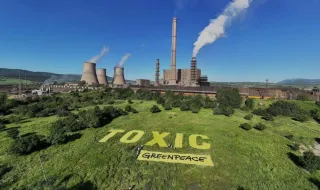
Bobov Dol TPP has received nearly €77 million in premiums for combined electricity and heat production over the five-year period from July 1, 2021, to June 30, 2026, while primarily heating facilities on its own site. This is shown by an analysis of payments made by the Electricity System Security Fund (ESSF), prepared by the environmental association For the Earth with the support of Greenpeace Bulgaria. The data was obtained under the Access to Public Information Act.
The share of high-efficiency production at Bobov Dol TPP doubled during the period, from nearly 11% in 2022 to more than 20% in 2025. However, this plant is not a conventional district heating company—it does not provide district heating services to household customers.
Why is it important for Bobov Dol TPP to produce heat as well? Because of the premiums it receives for electricity generated in combination with heat. In so-called combined production, the heat released during electricity generation is utilized instead of being discharged as waste. When it achieves a certain level of savings compared with separate electricity and heat production, combined production is supported with premiums from the ESSF.
In 2018, Bobov Dol TPP was granted a license to produce heat in addition to electricity. [1] A decision by the Energy and Water Regulatory Commission (EWRC) from June 2025 [2] describes curious findings from an inspection by the Ministry of Energy (ME): Bobov Dol TPP had signed an agreement to supply heat to a greenhouse operated by the company Bloom Fetish on an adjacent property, but it does not hold a license to transmit heat. In addition, there is no data on the heat-metering device for the greenhouse.
According to the findings of the ME inspection, the other “consumer” of heat from Bobov Dol TPP is Heath Energy EOOD—a company operating on the TPP’s site and linked to the Kovachki Coal Empire. Interestingly, Heath Energy’s service is thawing coal wagons on the territory of the plant, and this takes place year-round. The inspection found that in some summer months, the amount of heat produced using steam was greater than in some winter months.
Bobov Dol TPP also sells heat to itself, the ME found. Its own property, the “Workers’ Canteen,” has been leased out, and an addendum has been signed for the supply of heat and hot water. Thus, heating for “own needs” becomes a state-subsidized district heating service. Despite the ME’s findings, the EWRC confirmed Bobov Dol TPP’s right to receive premiums.
The current rules on energy premiums do not take into account the impact of energy production on the environment and climate. Bulgaria is required to introduce such requirements under the 2023 Energy Efficiency Directive, but is more than a year late.
“Bulgaria is delaying key requirements that would take into account the impact of combined energy production on public health and the climate. As a result, our energy system continues to distribute subsidies that do not support the transition to a sustainable, low-carbon economy and, in some cases, keep facilities operating that pollute and endanger people’s health. Such an approach comes at a high financial and human cost,” said attorney Regina Stoilova.
“Subsidizing one of the most polluting coal-fired power plants cannot be an investment in the security of the energy system. When habitual violators receive bonuses instead of sanctions, against a backdrop of extensive evidence of abuses, we all pay the price—but it is especially high for our fellow citizens living under the chimneys of Bobov Dol TPP, who pay with their health. It is time for the state to end its toxic dependence on chronic polluters and invest in genuine security—local renewable energy sources with citizen participation,” commented Desislava Mikova, coordinator of Greenpeace Bulgaria’s Climate and Energy campaign.
Premiums instead of sanctions
In 2025 alone, Bobov Dol TPP received €20 million in premiums for combined electricity and heat production. In the same year, two separate monitoring stations in the nearby village of Golemo Selo recorded a total of 55 exceedances [3] of the hourly average limit for sulfur dioxide. Both stations recorded more than the 24 exceedances permitted by law, although neither operated throughout the entire year. This is not an isolated incident at all, but the systematic behavior of a chronic polluter, as also evidenced by publicly available data since 2019 [4].
Despite the repeated violations, Bobov Dol TPP continues to operate and receive bonuses from the state, while the responsible institutions have failed to find a lasting solution to the problems caused by the chronic polluter. In May 2026, one of the units was shut down because of numerous violations. [5] Two months later, the Environment Ministry restarted the sealed power boiler, announcing that all problems had been resolved. [6]
The plant has been shut down again for three weeks, this time for undisclosed reasons. [7] Juggling the units of a habitual violator, however, is not an energy strategy, nor can it satisfy the plant’s workers or local residents affected by chronic pollution.
We pay to be poisoned
In addition to Bobov Dol TPP, other plants receiving bonuses for high-efficiency electricity and heat production are Brikel, Ruse District Heating, Sliven District Heating—Engineer Angel Angelov, and Pernik District Heating. All of them are identified as part of the Coal Empire linked to Hristo Kovachki [8], and most have been documented as systematically polluting the environment.
A total of €610 million in subsidies was paid to these five coal-fired plants over the five-year period from July 1, 2021, to June 30, 2026.
Sources:
[1] EWRC decision, 2018 https://www.dker.bg/uploads/reshenia/2018/res_i3-l-094_18.pdf
[2] EWRC decision, 2025 https://www.dker.bg/uploads/reshenia/2025/res-s-6-2025.pdf
[3] Greenpeace Bulgaria. No Limits to Arrogance: Bobov Dol TPP Is Poisoning with Sulfur Dioxide and Wants to Burn Five Times More Waste. 5.02.2026 https://www.greenpeace.org/bulgaria/press/11448/naglost-bez-predel-tec-bobov-dol/
[4] Greenpeace Bulgaria. The Secret Gassing by Bobov Dol TPP Comes to Light. Greenpeace Bulgaria Calls for the Plant to Be Shut Down. 26.06.2025 https://www.greenpeace.org/bulgaria/press/10721/tainoto-obgaziavane-ot-bobov-dol/
[5] Greenpeace Bulgaria. Bobov Dol TPP Lies, Unions Cover Up. Greenpeace Bulgaria Presents New Data on Further Toxic Pollution. 3.06.2026 https://www.greenpeace.org/bulgaria/press/13220/novi-toxic-danni/
[6] BTA. The Compulsory Administrative Measure Imposed on Bobov Dol TPP Has Not Been Lifted as of Now, Minister Rositsa Karamfilova Says. 12.06.2026 https://www.bta.bg/bg/news/bulgaria/national-news/1146045-nalozhenata-prinuditelna-administrativna-myarka-na-tets-bobov-dol-kam-nastoyas
[7] Actualno.com. Bobov Dol TPP Has Stopped Operating Again. 3.11.2026 https://www.actualno.com/kustendil/tec-bobov-dol-otnovo-e-sprjal-rabota-news_2658143.html
[8] Greenpeace Bulgaria. “The Eight Circles of Kovachki’s Coal Empire.” 7.07.2022 https://www.greenpeace.org/static/planet4-bulgaria-stateless/2022/07/8562f1fb-doklad-vaglishtna-imperia.pdf