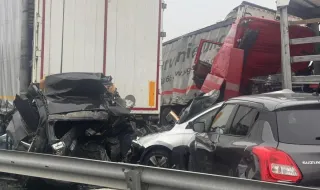
The Institute for Road Safety warned that the introduction of dynamic information boards, digital systems and new cameras cannot, on its own, solve the road safety crisis. The statement was published following the serious pile-ups on the Trakia motorway near the Zimnitsa interchange, in which 12 people were killed, according to data reported by the government. The Ministry of Health said that 51 injured people had been admitted to medical facilities.
Following the tragedy, the authorities announced the creation of a unified national road safety information centre. The system is expected to consolidate real-time data and provide information to electronic boards along the motorways. The measures were presented as part of efforts to warn drivers about dangerous sections, incidents and changes in traffic.
According to the IRSA, this repeats an approach already in use, whereby an individual technological solution is presented as the main response to a systemic problem. The institute cites the introduction of average speed enforcement last year, under the government led by Rosen Zhelyazkov, as a previous example.
The organisation clarifies that it does not reject average speed enforcement, cameras or dynamic boards. Its criticism concerns the way these tools are introduced and managed. The statement claims that the average speed system was not provided with the necessary technical, metrological and organisational preparation, nor with a clear risk management framework.
“Neither average speed, nor dynamic boards, nor cameras can independently reduce road traffic injuries and fatalities,” the Institute for Road Safety said.The IRSA also refers to its own study, based on responses from the Bulgarian Institute of Metrology. According to the institute, the data raise questions about metrological assurance, synchronisation, information integrity and responsibility for the final measurement result. The organisation claims that the average speed system is increasingly turning into a tool for generating revenue for the Road Safety Fund, rather than a means of comprehensive risk management.
IRSA calls for a clearly responsible entity
The statement says that Bulgaria is not suffering from a lack of technology, but from a lack of responsible management. According to the institute, individual projects have been created and public funds have been spent over the years, but no permanent professional team has been established to bear personal and institutional responsibility for the results.
The IRSA warns that, following the crash, new tens of millions of euros could be spent on technological solutions. The organisation asks who will be held responsible if these investments do not lead to a real reduction in the number of fatalities and injured people.
The institute calls on the prime minister to announce an open competition for the development of a road safety risk management framework. According to the proposal, it should identify a specific responsible entity and management team, daily risk assessment mechanisms, targets for reducing fatalities, deadlines and measurable indicators.
The demands also include the creation of a mechanism for public oversight of the spending of funds and the results achieved. “Road safety is not a PR campaign. It is daily risk management and responsibility for human life,” the IRSA said.