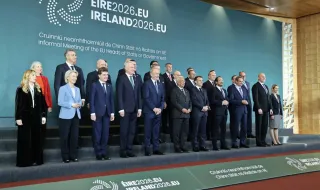
Bulgaria supported with reservations France’s initiative on key principles for guaranteeing European security. This is an important declaration that we accept and welcome, with our reservations concerning only the preamble, Prime Minister Rumen Radev told journalists before the start of the informal European Council meeting in Dublin. The prime minister reaffirmed our country’s support for the document, which sets out clearly defined principles for joint efforts to counter organised crime, terrorism, hybrid attacks, the production and distribution of drugs, and illegal migration.
At the same time, the prime minister recalled that high-level diplomatic negotiations are currently under way for a peaceful resolution to the war in Ukraine. It is precisely in this context that the language of common European documents must reflect the dynamics of these political processes, particularly with regard to the negotiations. “That is why we also expressed reservations about the preamble to the declaration, so that the wording reflects this dynamic, allowing us to have a broader scope for dialogue and not exclude peaceful solutions in their entirety,” Radev said. As an example, the prime minister pointed out that earlier versions of the preamble had emphasised the importance of and expressed support for the peace talks in Abu Dhabi, but that this text was absent from the final version. “We insist that such a text be included. We insist that this be taken into account and that we under no circumstances narrow the scope for dialogue, as well as the options for finding peaceful solutions,” Radev said.
The prime minister emphasised the extremely important role of the United States regarding the war in Ukraine, expressing confidence that it is precisely the United States that can be the force to compel both sides to sit down at the negotiating table. “The United States has sufficient leverage to do so, and we are seeing movement in this direction,” Radev said.
Asked by the media about discussions on a new European loan for Ukraine, Prime Minister Rumen Radev recalled that our country is subject to an excessive deficit procedure, which necessitates financial discipline, but that Bulgaria is not obstructing the decisions of other member states to provide such assistance. “Whoever decides to help and invest financial resources in whatever they choose should do so. In this situation, we are not blocking anyone,” Rumen Radev said.
The prime minister also stressed that Bulgaria is the EU country with the largest historical community in Ukraine and that it is the task of the Bulgarian government to help these fellow Bulgarians live in peace as soon as possible and have access to education, healthcare, electricity and heating, and that this will not be resolved through investments in armaments. In this regard, Bulgaria is ready to discuss the creation of mechanisms to guarantee that any financial assistance it provides will go not towards weapons, but towards humanitarian activities and support with electricity and medical services aimed at the Bulgarian community in the country.
The prime minister also recalled our country’s clearly formulated position in support of international initiatives seeking a peaceful solution. “I do not accept the imposition of peace from a position of strength. Because we saw—and I said this a year and a half ago—that this would lead only to more casualties, more destruction and an even greater escalation of the conflict, which is now a risk not only for Europe, but for the entire world,” Rumen Radev said.
The prime minister also noted that the export of weapons from our military-industrial enterprises to Ukraine is progressively declining in view of the technological transformation during the course of the war and the increasing use of drones. “We have a clear position that we will not provide any more weapons and ammunition from the warehouses of the Bulgarian Army. I stated this clearly when our government assumed office,” Radev recalled.
In response to a journalist’s question as to whether Bulgaria would rejoin the “coalition of the willing” for Ukraine, Prime Minister Radev said: “There is no way we can accept this coalition’s drive to form military units that are ready—and have already begun training—to be sent to Ukrainian territory. We have a clear decision by the Bulgarian parliament that our soldiers will not participate in such missions. So my position here remains unchanged,” the prime minister said.
At the same time, the prime minister noted that there are two clear frameworks for decision-making: the European Union and NATO, and that Bulgaria actively participates in shaping their policies. “All other initiatives undermine our unity to a greater or lesser extent,” the prime minister added.