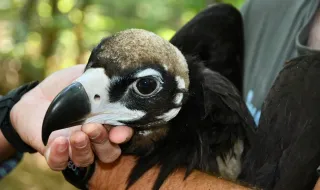
It is a rare opportunity to see cinereous vultures up close. And they really are impressive. Their wingspan can reach 3 metres. Europe’s largest bird of prey is also nature’s most diligent cleaner. That is precisely why conservation organisations are making tremendous efforts to bring this key species back to Bulgaria’s wild landscapes.
Together with experts from the Rewilding Rhodopes Foundation and the Bulgarian Society for the Protection of Birds, we travel to a remote area in the Eastern Rhodopes near Madzharovo. After several months of adaptation, 5 new cinereous vultures are about to take flight freely into their new life here.
The door of the aviary opens, and we quietly observe the behaviour of the young birds from a special hide to the side. Some take flight immediately, while others are in no hurry.
Dr Dobromir Dobrev from the BSPB explains: "The birds are calm. They will need some time, perhaps several hours, to come down to the ground from their perches. After that, they will go outside freely".
As of 2026, the total number of cinereous vultures that have adapted and taken flight in the Eastern Rhodopes is 45. They come to our country from Spain. Some of them are from rescue centres, while others are offspring of pairs raised with human assistance. In both cases, after arriving in Bulgaria in spring, they spend several months in an aviary to get used to their new home.
"Here, the birds are placed literally in their natural environment. In nesting habitat. Close to other vultures that feed in front of them," Dobrev also explains.
In this way, the newcomers establish their first social contact with the local birds. They imprint the characteristics of the environment and the behaviour of their Bulgarian counterparts. Once they find themselves free, the vultures are left without protection in an unfamiliar place.
Hristo Hristov from the Rewilding Rhodopes Foundation adds: "Although the cage is quite large and they have the opportunity to exercise there, the first flight is rather uncertain. Their muscles are well developed, but they do not have the skills for a long flight".
Even after taking flight into the wild, the vultures are under constant observation at first. Usually, during the first few days, they land in high, open places or on the platforms built in the trees. Every day they make short and uncertain flights until they gain the confidence to cover longer distances.
"Every bird has a GPS transmitter on its back. We also combine remote monitoring with actual tracking using binoculars," Hristov also says.
For days, experts from the BSPB and the Rewilding Rhodopes Foundation peer through their binoculars. They follow how each bird copes with the challenges of the wild in the Rhodopes. For volunteers like Dobri, the hours spent outdoors are priceless lessons in conservation.
Dobromir Yordanov is a volunteer. He says: "I was studying programming and I burned out. I told myself that I wanted to be close to nature, something I had liked as a child. Life in front of a computer had become too much for me".
However, the best cleaners in the wild turn out to be victims of the good they do. We constantly witness cases in which vultures come across poison placed by humans for predators.
"So much effort, so much care. We are not even talking about how much all of this costs. But the effort, the care and the emotional loss are immense," Hristov also shares.
Despite everything, observations of the cinereous vultures that have already been released offer great hope. 20 of the birds have survived and continue to fly over the mountain. 7 of them have occupied nests. Pairs are gradually forming and producing offspring.
"This year, we have the first pairs that have managed to raise offspring. We have two chicks that have fledged from their nests," Dobrev explains.
The programme to restore this invaluable species to the Rhodopes continues until 2029. At least 2 more groups of several vultures will arrive from Spain to adapt and take flight into the wild across the endless mountain landscapes of the Rhodopes.