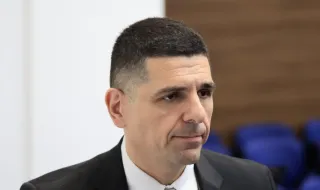
Bozhidar Bozhanov and I were approached by YouTuber Stanislav Tsanov, who said he had highly disturbing information about DANS’s influence over Iva Mikhailova—about threats that her rehabilitation would be stopped and about whom she should appear with and in which media outlet. Our job as co-chairmen of “Yes, Bulgaria” on the political level is to establish whether there has been improper influence by DANS. There is no doubt that over the years DANS has crossed the line, both through its teams and through deputy chairmen. But when it comes to human life and a scandal with the potential to go beyond Bulgaria’s borders, it was important to establish the truth about DANS’s influence. That is why we will call for a temporary parliamentary committee, hearings in committees and in the plenary hall, and we will also turn to the European Parliament through our MEPs, because in our parliament the practice is for such hearings not to take place—the governing parties block requests for them with their 131 votes. This was said by the co-chairman of “Yes, Bulgaria”, Ivaylo Mirchev, on Darik Radio’s “Darik Cafe” programme.
We have every indication that Iva Mikhailova’s recordings are identical. We were approached after they had already become public; we had nothing to do with their publication. Our goal is to help Iva. When the security services issue threats, we are ready to immediately take over the full cost of her treatment and legal defence so that she can feel calm and safe.
If anyone expected DANS to admit it, then they do not know DANS. In 2020, dozens of protesters were wiretapped under extremely scandalous circumstances; before that there was the “Gallery” case, so DANS has a clear tradition. There is no doubt that, in one form or another, there was intervention regarding Iva. The question is whether they acted outside the law; it is secondary whether there are YouTubers who are in some way under DANS’s influence and are fed certain talking points and guests. We want to establish what DANS’s role is—that is our job as a political force.
Ever since it was established, DANS has served the powerful of the day—regardless of whether Peevski or Radev is at the forefront. It is of no concern to us which vlogger or YouTuber Iva was going to appear with, but we are concerned if DANS is using certain journalists and media outlets to promote narratives and disinformation serving Russian interests, which has been identified as a major problem within NATO and the EU. I will not analyse Iva Mikhailova’s interview with Karbovski, but anyone who watches it can draw their own conclusion about the direction in which the host is steering the conversation. The major problem here is the risk to national security.
DANS is not working on the Russian front. They have also downgraded the department dealing with Russia, while almost no work is being done on the Russian front at the State Agency for Intelligence either. Counterintelligence has no disclosures concerning Russia; we are an unguarded house, which is why our international partners do not share any significant information with us, because they know it immediately leaks to the Russian services and because they cannot receive assistance from us against Russia’s hybrid operatives.
The collaboration between “Vazrazhdane” and “Progressive Bulgaria” is a fact, and I expect it to develop in other areas as well—over the budget and perhaps in the election of the Supreme Judicial Council. This creates further problems with Russian influence in our country. Ships have been sunk by Russian drones miles from the Bulgarian coast, and the governing parties’ collaboration with “Vazrazhdane” is, to put it mildly, strange.
We want the budget to be reconsidered and submitted with a 3% deficit. The budget contains €2.4 billion that no one knows what it is for, probably for the municipalities. So, if no one knows what it is for, the budget can be returned and we can have a more adequate budget and deficit. But the governing parties have planned to take out a €6 billion loan—twice as much as is needed to cover the deficit. Next year alone, we will pay €1.5 billion in interest, while just three years ago we were paying three times less. But the governing parties have taken care to set aside a significant amount for municipal projects ahead of the local elections; there are indications that mayors are being told they will receive the money if they support “Progressive Bulgaria”. At the very least, they could have created a register of municipal projects showing clearly who is paid and when, instead of every payment decision depending on the prime minister and his chief of staff, Koprinkov.
Besides “Standard & Poor’s”, the Fiscal Council has also levelled serious criticism at the budget. The budget could be more ambitious. There are between 12,000 and 22,000 vacant positions in the administration, of which 2,500 are officially being cut. This is not a reform at all. S&P are saying the same thing: when we raised the outlook on your credit rating from “stable” to “positive” six months ago, there were two reasons—the political stability and the stated desire for reforms. Now political stability is in question, and there is no desire for reforms. In six months, there has not been a single serious reform, with the exception of machine voting, which was based on our idea and our proposals.
Over the years, we have criticised “Kaufland” for its trade practices towards Bulgarian producers. There are other chains from the same group with a much fairer approach to Bulgarian producers. These chains must understand that they have to comply with the law. “Kaufland” has in fact been fined before, but the sums were very small and attracted nobody’s attention. An end must be put to the way “Kaufland” treats Bulgarian producers. On the other hand, however, the Commission for Protection of Competition has been notoriously compromised over the years. There was, for example, one chairman of the CPC who admitted in a private conversation: “I cannot make a decision without the prime minister,” and the prime minister at the time was Boyko Borissov. That is why, when there is such a large fine, it raises certain suspicions, but all of this is decided in court.
The government can hardly interfere in prices, nor should it. But it can do something else, in line with our proposal, which was rejected by the cabinet but adopted in Germany—to deduct 20 euro cents per litre of diesel or petrol for consumers. This would be financed through increased VAT revenue resulting from higher prices, as well as by taxing the windfall profits of “Lukoil” and the entire oil sector. Instead of this money going into Russian accounts, it should be returned to Bulgarian citizens. But the governing parties are not planning a windfall-profits tax for the oil sector. And “Lukoil’s” profit, especially after the ban on diesel exports was lifted, is expected to be around €2 billion. Instead of this windfall profit leaving Bulgaria, it could go into the pockets of Bulgarian citizens. And the discount could already reach not 20 but 40 euro cents, which would also be an anti-inflationary measure, because companies would have no argument for raising prices.
The methodology of the windfall-profits tax is flawed. If a company had a very high profit in 2025 but it fell sharply in 2026, the windfall-profits tax could turn out to be its entire profit—not 33% but 100%. And then it automatically becomes the old turnover tax. When a company sees that its entire profit will be taken away, it is motivated to raise prices, and that creates an inflationary effect. In other words, instead of curbing inflation, the governing parties will deepen it.
Bulgaria is now the only country in the EU supporting the Russian position. We from DB are ready to take to the streets with the people to defend our country’s independence. There must not be a new Yalta; there must not be a new redrawing of borders. Russia cannot dictate which alliance a country should belong to or whether France and the United Kingdom can extend their nuclear umbrella over all European countries. This is unacceptable, and I hope that either the Bulgarian government will correct its position, or we will use all legal measures to defend our view.