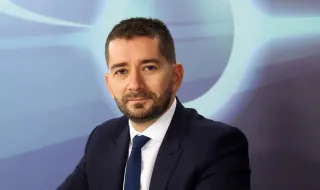
With the 2027 Budget bill, the government is now genuinely assuming its powers, said Slavi Vasilev, deputy chairman of the parliamentary group of „Progressive Bulgaria“, on NOVA’s programme „Crossroads“.
„With the 2027 Budget, the government is now genuinely assuming its powers,“ Vasilev said. In his words, the budget framework puts an end to indiscriminate spending, while expenditure is falling for the first time in many years.
The Council of Ministers approved the draft state budget for 2027 and sent it to the European Commission and the Eurogroup. The projections include a cash deficit of 3.5% of gross domestic product, compared with 5.7% in 2026. The government presents this as a consolidation of public finances and a limitation of new borrowing.
Less funding for some institutions
„If one looks at the figures, one will see that in 2027 the state’s expenditure is falling by the entire amount of €1 billion,“ Vasilev said. He clarified that some institutions would receive less funding, but in his view this is inevitable given the need to reduce the deficit.
Vasilev pointed to the Ministry of the Interior as a sector where employees will not receive a further pay rise. „It is normal for people in the Ministry of the Interior to feel some frustration with the parameters set, because salaries in the „Security“ sector will not increase,“ he said.
The draft presented by the Ministry of Finance provides for a 5% increase in personnel expenditure in most budget-funded structures. Elected officials and those employed in the „Defence and Security“ sectors are excluded. A 7.5% increase in remuneration is planned for teaching professionals, while pensions are expected to be uprated by around 8%.
Social payments remain among the priorities
Regarding the Personal Assistance Act, Vasilev said that in 2027 funding for personal assistants would reach €1.2 billion. He said that no changes were planned for next year, but that afterwards a new mechanism for calculating expenditure could be sought so that it does not grow at an accelerated rate.
The government says the budget preserves social support, raises the minimum wage from €620 to €660, and provides for higher pensions, student scholarships, and benefits for families and children. Prime Minister Rumen Radev said that incomes and social payments would not be reduced.
The next step is for the draft to be discussed by the National Council for Tripartite Cooperation, after which it will be submitted to the National Assembly for consideration and a vote. Individual parameters may be changed before its final adoption.
Sources: nova.bg, btvnovinite.bg