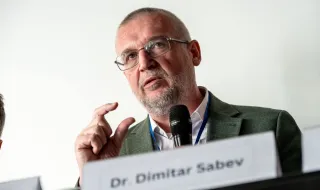
Bulgaria’s coal regions are paying a high price for energy production – and it is measured not only in the economic consequences of mining and power plant operations. In Bobov Dol, Galabovo and Radnevo, mortality is between 2.5 and 3 times higher than the European Union average. What are the reasons for this alarming statistic, what is the impact of the coal industry on people’s health, and why should the energy transition also be viewed through the prism of human life? Dimitar Sabev, a doctor of economics at the Economic Research Institute of the Bulgarian Academy of Sciences, speaks to FAKTI.
- Mr Sabev, you estimate that mortality in the coal municipalities – Bobov Dol, Galabovo and Radnevo – is significantly higher than the national average. What exactly do the data show?
- Coal energy – coal extraction and its combustion in thermal power plants – affects more than ten Bulgarian municipalities, but in the three you mention it is the sole industry, which is why I limited my analysis to them. My calculations show that, on average, these three coal municipalities record 6.8 deaths per 1,000 people above the national norm. Given the size of the population there, this means that a total of 220 more people die each year on average in the three coal municipalities than would be expected according to the Bulgarian norm.
It is well known that Bulgaria has the highest mortality rate in the European Union. If, instead of our country, we use an average European region as a benchmark – for example, one in Austria or Spain – it turns out that mortality in Bulgaria’s coal regions is 2.5 to 3 times higher than the EU average.
In absolute terms, more than 27 people per 1,000 died in Bobov Dol municipality in 2024, 24 per 1,000 in Galabovo, and 21 per 1,000 in Radnevo. That is an extremely high figure. The average mortality rate in the EU is around 10 per 1,000 people.
My calculations, which apply econometric models based on data from the National Statistical Institute, correspond to several previous international scientific estimates. For example, in 2021, a statistical model applied to countries across Europe calculated that the operation of thermal power plants in Bulgaria causes the premature deaths of around 480 people annually.
- To what extent can this alarming statistic be linked to the operation of coal-fired power plants? And what does this excess mortality mean in human terms?
- Your question is justified – however alarming they may be, the facts above do not in themselves prove that coal mines and thermal power plants are specifically to blame for the excess mortality. The factors overlap: for occupational reasons, the share of the male population is higher in coal municipalities, and men live shorter lives than women. The lifestyle of these people – I am referring to alcohol and cigarettes – is also a risk factor. The quality of healthcare services is poor: people in the coal regions may earn decent wages, but they are disadvantaged when it comes to hospitals and doctors, as well as schools.
Everything listed undoubtedly contributes to the extremely high mortality rate, but we cannot turn a blind eye to dust from coal mining and emissions from thermal power plants either. The systematic breaches of air-quality standards by some old plants – Brikel in Galabovo, Bobov Dol TPP, and Maritsa 3 TPP in Dimitrovgrad – are officially documented. Fine particulate matter, sulphur dioxide, nitrogen oxides, heavy metals and so on – year after year. Only the owner of a coal-fired power plant or a Bulgarian trade unionist would claim that these have no effect on health and mortality.
In terms of the human dimension, things are complicated. People in these regions are fully aware of the harmful effects, but, with the self-sacrifice typical of Bulgarian parents, they choose to stay and live and work there so that they can earn wages with which to help their children settle elsewhere. On an individual level, this sounds heroic; at a systemic level, it is disastrous and must not be allowed.
- You point out that, in addition to air pollution, population ageing, the departure of young people and insufficient access to healthcare contribute to the high mortality rate. How can we distinguish the influence of these factors from that of coal energy?
- Such a distinction can certainly be made using a statistical model, but this requires data on the health status of the population. That data would need to be collected over several years at the initiative of the state and then made available to researchers. Unfortunately, so far the Bulgarian state has shown no desire to uncover what exactly lies behind the record mortality rate in the coal municipalities. In practice, as far as the Bulgarian state is concerned, there is no problem of excess mortality in the coal municipalities.
- In 2025, 55 breaches of the hourly average limit for sulphur dioxide were recorded near Bobov Dol TPP, while independent measurements recorded levels averaging ten times higher than those officially reported. Why do we continue to have a problem with pollution control, and who should be held responsible?
- My explanation is that the interests of coal energy – I mean financial interests – have hidden supporters at a very high level of the state, far beyond the ministries alone.
Many of the control measures and the imposition of financial liability for pollution go through the courts, while coal companies, and especially the group surrounding Bobov Dol TPP, have powerful legal teams that have successfully sued the state on numerous occasions. The fact that the state lacks the legal capacity to stand up to them is absurd, of course. What the state lacks is not capacity, but the will.
- In a survey of 40 experts, you identified a strong statistical correlation between support for preserving coal capacity and the belief that coal energy poses no health risk. Does this mean that economic and political interests influence how health risks are presented?
- That is definitely the case: anyone who is in favour of preserving coal-fired power plants indefinitely sees no health risk in their operation. The results of the survey you are referring to were published in my monograph “Coal Regions after the End of Coal Mining”, issued by the Economic Research Institute of the Bulgarian Academy of Sciences, where I work. The book is freely available, and anyone interested can read it.
I conducted an actual survey among leading experts: former and current members of parliament, ministers, mayors, agency heads, professors and associate professors, trade union leaders, businesspeople and established experts – unquestionably an elite sample. But unfortunately, some of the most competent people in the country in the field of energy are biased in one direction or another. If you are in favour of preserving thermal power plants, these 220 prematurely dying people are an insignificant issue to you, or the calculations are “questionable”. If you support the immediate closure of thermal power plants, you see no risk of unemployment in the regions.
Incidentally, I too am in favour of preserving thermal power plants – but not all of them, not indefinitely and not in their current form. Another calculation in my monograph shows that staffing at the state-owned mines and thermal power plants is at least twice as high as that of comparable international enterprises. And there are certainly at least four morally outdated and polluting private thermal power plants in Bulgaria that should be closed immediately.
- You also mention that Radnevo and Galabovo are among the municipalities with the highest average wages in the country, while students’ results are far down the national rankings. How do you explain this paradox, and why do high industrial incomes not automatically translate into a better living environment?
- In my view, students’ results are among the most significant indicators of the situation in Bulgaria’s regions. It is indeed the case: in 2024, Radnevo municipality ranked fifth in gross wages among the country’s 265 municipalities, but ranked 193rd in the results of the national external assessment in mathematics after seventh grade. In Galabovo municipality, the 2021 census showed that 23% of the adult population had less than secondary education.
As an explanation, we must once again return to the distinction mentioned earlier: a place to earn wages and a place to build a home and family.
People in the coal municipalities have been reduced to working tools – which quickly wear out.
In recent years, advocates of coal energy have repeatedly called for us “not to allow the Green Transition to destroy these prosperous regions”. Well, the data I have cited so far show just how “prosperous” these regions are.
I should emphasise that the demographic collapse and the deterioration in the quality of public services in Bulgaria’s coal regions began long before discussions about the energy transition. Talk of the “Green Deal” only began three or four years ago. In my study, I show that the deep decline began long before that.
- So, what are the real reasons for the decline of the coal regions?
- There are many explanations, some of them common to the whole of Europe. Coal mining in the United Kingdom and Germany entered a phase of decline as early as the 1950s, due to the emergence of energy alternatives such as oil and gas; the same thing is happening now with renewables. More broadly, economic development based on coal has a life cycle: it reaches industrial heights, but decline always follows. At a certain point, coal energy begins to accumulate financial losses because it cannot compete in the market. Some wealthy countries support coal for a while with heavy subsidies, but even Germany cannot afford to do so indefinitely.
Incidentally, in Bulgaria this is characteristic not only of coal regions, but of municipalities with heavy mono-industry in general. It is telling that in the municipality where our largest metallurgical plant operates, unemployment is twice the average and people are moving away.
- Is it possible for the coal regions to be revitalised demographically if the economic model changes? What investments are needed for young people to start staying and raising families there?
- That is precisely my thesis: that it is possible. At first glance, this sounds strange after all the coal lobby’s talk of “mass depopulation and unemployment in the regions because of the Green Deal”. But European experience and economic logic lead precisely to this conclusion: decline has been present for a long time, but if the energy transition is carried out systematically and with people in mind, it will actually lead to stabilisation in the regions.
These regions have significant prerequisites for development. Maritsa-East has excellent energy and industrial infrastructure, is located in a key geographical position, and has thousands of workers with experience in industrial production who will be looking for new opportunities on the labour market.
With a systematic state policy for a gradual energy transition, these people and their regions could have a completely different future. I speak of a “state policy”, but joint efforts by Bulgarian business, academia and institutions are needed – not new inefficient state-owned enterprises to replace the old inefficient capacity with the aim of providing some kind of work for those who have been laid off.
Around the world, this approach of state, business and academia working together for national advancement is called industrial policy – hence the subtitle of my monograph, “A New Industrial Policy for Bulgaria”.
- Which specific industries could replace the coal sector, and how realistic is it to carry out such a transformation in Bulgaria?
- How realistic was it for Korea, until the 1960s a poor rural country, to become the economic giant it is today?!
The specific industries will be determined by the market, but the characteristics of the location outline the main opportunities. Industrial parks are already being developed in Maritsa-East, where manufacturing based on the machining of components is planned. The idea of focusing on medium-technology mechatronics industries has long been proposed. There are plans for a new chemical industry. The creation of a hydrogen valley is a promising possibility. New businesses could emerge through orders for the needs of the defence industry. In Stara Zagora, there are also long-standing ideas for developing more technologically advanced manufacturing, including parts for Europe’s aircraft industry.
In addition, Maritsa-East has the potential to become a logistics hub in international supply chains along the route from the East to Western Europe. Renewable energy capacity should be developed on the land damaged by coal mining, taking advantage of the powerful existing energy infrastructure. The region is in the south, its soils are fertile, and if the current dirty industries are abandoned, there is also room for expanding agriculture.
That is the situation in Maritsa-East, while Bobov Dol is only an hour away from Sofia’s labour-hungry market, which will easily “swallow up” workers released from the coal energy sector. The same applies to Pernik. Even the suggestions outlined above, which I have developed in greater depth in my monograph, show that economic opportunities exist. What is missing is statesmanlike thinking.
-----------------------------------------
Dimitar Sabev holds a doctorate in economics and currently works at the Economic Research Institute of the Bulgarian Academy of Sciences. He is the author of numerous scholarly and popular publications and several books, including Marketing, Consumption and Economic Growth (2022) and Bulgaria’s Mountain Regions: Economy and Population (2024). His interests focus on what is known as econology: the point where nature, the market and culture intersect. In the summer of 2026, his new monograph “Coal Regions after the End of Coal Mining” was published. He is an author at Climateka.