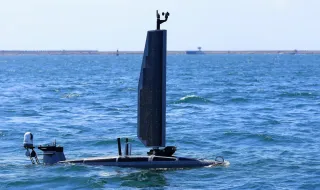
After seven reported attacks on merchant ships in the Black Sea, the question is no longer only who is behind the drones, but also how Bulgaria should respond. The latest incident occurred on November 16, when the vessel BETUL 8 was attacked approximately 40 nautical miles southeast of Cape Kaliakra. All 12 crew members were rescued by Bulgarian military forces.
The sailors told BNT that they had been attacked by two maritime drones. The international news agency Associated Press noted that there is currently no official confirmation that the sinking was caused by a drone strike, although the crew described it that way. This distinction is significant because the origin of the devices and responsibility for the attacks remain unestablished.
Call for Immediate Destruction
Former Deputy Minister of Defence Yordan Bozhilov and journalists Valeriy Todorov and Chavdar Stefanov discussed the need for stronger action on bTV. Bozhilov called on Bulgaria and Romania to begin talks in the European Union on a joint mission modeled on the operation to protect shipping in the Red Sea.
According to him, attacks in the exclusive economic zone should be treated as a direct threat to shipping, regardless of whether the drones’ origin has been established. Bozhilov also said that international law does not prohibit the destruction of drones in the exclusive economic zone, but the practical decision depends on identifying the threat and on the authorization to use force.
The State Is Waiting for Evidence
The government’s official position is more cautious. Bulgaria requested technical assistance from the European Union and NATO after no drone debris was found in the previous attacks. The aim is to examine physical evidence, satellite data and the information collected before an alleged perpetrator is named.
The government said that once responsibility has been unequivocally established, Bulgaria will take diplomatic and legal measures in accordance with international law. This means that, at present, Sofia has not publicly announced a decision to systematically shoot down drones in the exclusive economic zone.
This is precisely where the main dispute lies. Supporters of a tougher response point out that waiting could turn the attacks into a recurring pattern and increase the risk to crews, vessels and trade routes. Opponents of immediate strikes warn that shooting down a device without proven origins could lead to escalation and a misjudgment of the situation.
What Comes Next
The parliamentary Defence Committee is due to hear Defence Minister Dimitar Stoyanov on the attacks, the possibilities for surveillance and countermeasures, and the assistance Bulgaria expects from its allies. Meanwhile, Bulgaria, Romania and Turkey have already agreed on a mechanism for information sharing and coordination in the Black Sea.
Thus, the decision facing Sofia is divided into two parts: the immediate protection of shipping and establishing responsibility for the attacks. The first requires capabilities to detect and neutralize drones. The second requires data that, so far, have not been presented publicly.
Sources: btvnovinite.bg, bntnews.bg, apnews.com