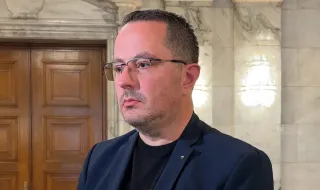
“There will be no Latin script” – this is how Revival co-chairman Tsoncho Ganev commented on the bill on the Bulgarian language in an interview for the “Face to Face” programme. According to him, the bill aims to restrict the use of foreign languages in state institutions and public spaces and to establish the Bulgarian literary language in official signs.
Asked how “Stara Planina” would be written, Ganev replied:
“It will be written in Bulgarian – “Stara Planina”, everywhere. There will be no Latin script. We will write Council of Ministers in Bulgarian, and it will not be written in any other language. The Presidency will be written in Bulgarian.”
The National Assembly passed the bill at first reading on 4 November 2026, with 153 votes in favour. The parliamentary information lists 2 December 2026 as the deadline for proposals between the first and second readings. This differs from the summary in the interview, where the deadline is described as having been extended to the maximum of three weeks.
What the bill provides
The bill’s explanatory notes state that it should create a comprehensive legal framework for the state language policy. It provides for the use of the Bulgarian literary language to be regulated in the public sphere, including in the administration, education, media and electronic communications.
The bill also provides for the establishment of an Advisory Council for the Bulgarian Language under the Council of Ministers. According to the parliamentary information, the council is to have expert advisory functions, assist in preserving and developing the language, and present an annual report on the state of the language environment. The explanatory notes also state that the bill does not affect the personal and unofficial use of the language.
Signs on institutions
Ganev said that the mandatory use of the Bulgarian language should cover state institutions and signs in public places. As an example, he pointed to police vehicles, on which, in his view, Bulgarian should take precedence over English.
“It is not normal for foreign languages to be displayed at every state institution. It is not normal,” said the Revival co-chairman.
On the subject of international conferences, Ganev explained that the bill does not regulate the language in which international meetings are conducted. According to him, interpreters can be provided in such cases, or a common working language can be determined in advance.
Ganev acknowledged that the text contains spelling errors, but rejected claims that the bill provides for signs written in shlyokavitsa. He described the language, the Orthodox faith and the family as key factors in preserving Bulgarian identity, and pointed to France, Poland, Hungary and Romania as countries where the local language has a leading role in public communication.
Sources: btvnovinite.bg