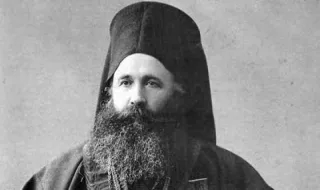
At the end of 1913, the Bulgarian Exarchate leaves Constantinople and moves its seat to Sofia. The decision comes after the Balkan War and the Second Balkan War, which almost completely dismantle the exarchal administration in European Turkey. Exarch Joseph I settles in the Bulgarian capital, while leaving an exarchal vicegerency in Constantinople headed by Metropolitan Meletius of Veles.
Historical references cite different specific dates for the move. The Bulgarian Patriarchate identifies November 24, 1913, as the day on which, due to his deteriorating health, Exarch Joseph settled in Sofia. The Bulgarian News Agency notes November 26, while the Regional History Museum – Sofia gives November 27. What these accounts have in common is that the move took place at the end of November 1913.
The Exarchate remains in Constantinople for more than four decades
The Bulgarian Exarchate was established by a sultan's firman dated February 27 Old Style, or March 10 New Style, 1870. It was the first officially recognized Bulgarian institution in the Ottoman Empire, and its seat was designated as Constantinople. The Exarchate Statute, adopted in 1871, regulated the structure and activities of the church organization.
After the Liberation in 1878, Exarch Joseph I remained in Constantinople. From there, he maintained relations with the Ottoman authorities and directed church and educational affairs among the Bulgarians who remained outside the borders of the Principality of Bulgaria. His main task was to preserve the national consciousness of the Bulgarians in Macedonia, Adrianople and Aegean Thrace.
The results of this work can also be seen in the scale of the educational network. During the 1912–1913 school year, 1,373 schools operated in the exarchal territories, including 13 secondary schools and 87 lower secondary schools. A total of 78,854 students attended them, while the number of teachers was 2,266.
A vicegerency remains in Constantinople
After the wars, the Bulgarian church structure in Macedonia and Adrianople was fragmented, and Exarch Joseph no longer had his former diocese. Metropolitan Meletius of Veles remained in Constantinople as the exarchal deputy. Later historical studies define this vicegerency as an institution that continued to represent Bulgarian church affairs among the Bulgarian community remaining in the Ottoman Empire.
The loss of the exarchal dioceses was a heavy blow to Joseph I. In a conversation with Tsar Ferdinand, recounted by the Regional History Museum – Sofia, the Exarch said:
“There is nothing more for us to say to each other. What I built over the course of thirty years, you destroyed in three.”
Exarch Joseph I died in Sofia on June 20, 1915. After his death, no new exarch was elected, and the Bulgarian Church was governed by the Holy Synod through acting chairmen. In 1953, the Bulgarian Exarchate was elevated to the status of Bulgarian Patriarchate.
Sources: bta.bg, pravoslavie.bg, archives.bnr.bg