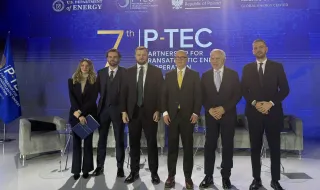
Bulgaria presented progress on key gas and nuclear projects during the Seventh Ministerial Meeting of the Partnership for Transatlantic Energy Cooperation (P-TEC), held in Warsaw on November 18 and 19. Representatives of governments, energy companies and institutions from Europe and the United States took part in the forum.
“Bulgaria is an active participant in efforts to strengthen energy security and connectivity in Eastern and Southeastern Europe,” said Energy Minister Iva Petrova. According to her, the country is developing strategic infrastructure, nuclear energy and international partnerships with the aim of ensuring more secure and diversified supplies.
Higher Capacity Along the Vertical Gas Corridor
Among the main topics discussed with the U.S. side were the results achieved under the Vertical Gas Corridor. According to the Ministry of Energy, the natural gas transmission capacity from Greece to Bulgaria has increased by 40% following the commissioning of the Kulata–Kresna section.
Transmission capacity from Bulgaria to Romania has also increased by nearly 90% following the completion of the Rupcha–Vetrino section and the reversal of the Kardam compressor station. The new daily capacity is already being offered on the market, the Bulgarian energy ministry said. The data on the increase were also presented by Kiril Ravnatchki, executive director of Bulgartransgaz.
Focus on Nuclear Energy
Iva Petrova and U.S. Secretary of Energy Chris Wright reaffirmed their commitment to the project for Units 7 and 8 of the Kozloduy Nuclear Power Plant. The talks covered investment, technological cooperation and the diversification of nuclear fuel supplies.
Within the framework of the forum, SGE, the National Electric Company and Blue Bird Energy signed a memorandum to explore the possibilities for deploying BWRX-300 small modular reactors in Bulgaria. The parties will assess potential sites, financing and implementation models, as well as licensing and regulatory requirements. The agreement does not constitute a final decision to build reactors, but marks the beginning of a joint study.
Talks with Greece and Hungary
During bilateral meetings, Bulgaria and Greece discussed seeking broader European support to curb high energy prices. Further discussions with Greek Minister Stavros Papastavrou and Hungarian Minister István Kapitányi covered the expansion of gas and electricity infrastructure and overcoming the restrictions on cross-border transmission.
Deputy Energy Minister Dr. Lyubomira Gancheva presented Bulgaria’s experience in preparing the project for Units 7 and 8 of the Kozloduy Nuclear Power Plant. She emphasized the need for a clear distribution of responsibilities and risks among the state, technology suppliers, contractors and financial partners.
The Bulgarian delegation also included representatives of the Bulgarian Energy Holding, “Kozloduy NPP – New Builds,” the National Electric Company, Bulgargaz and Bulgartransgaz.
Sources: dnes.bg, 3e-news.net, bta.bg