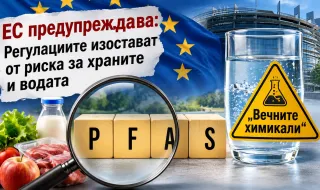
The Association for Accessible and Quality Food is urging Bulgarian institutions to publish information on the monitoring of per- and polyfluoroalkyl substances (PFAS) in food and drinking water, including which products and water sources are tested and what the results are.
The position was presented by the organization’s chair, engineer Dr. Andrey Velchev, following a special report by the European Court of Auditors dated November 18, 2026, on the European Union’s policy regarding so-called “forever chemicals.” The auditors warn that regulations are lagging behind the risks, that many PFAS are not registered under European chemicals legislation, and that restrictions are being introduced slowly. According to the report, the procedures take around five years on average, while one-third of the member states do not conduct checks to ensure compliance with the restrictions.
The Limit Does Not Equal Complete Safety
The European Court of Auditors points out that the current limits for PFAS in food and drinking water are not based on the latest scientific data. The auditors explicitly note that legal thresholds do not always guarantee safety in cases of regular and prolonged consumption. The report also states that more than 1,400 PFAS are used in various products and applications.
European legislation sets maximum levels for four substances from the group in certain foods of animal origin. For drinking water, parametric values have been established at 0.10 micrograms per liter for the sum of certain PFAS and 0.50 micrograms per liter for total PFAS. However, the European Court of Auditors warns that these restrictions may not fully reflect the accumulation of contamination and the latest scientific assessments.
The European Food Safety Authority identifies a reduced immune response to vaccines as the most critical health effect in the assessment of PFAS. Fish and eggs are among the foods that contribute most to dietary exposure, while children are among the more heavily exposed groups because of their higher food intake relative to their body weight.
The Association Calls for Specific Answers
“We may have a product that meets the current regulatory requirements, but that in itself does not mean that all long-term risks have been ruled out,” Velchev said.
According to him, the lack of representative data cannot be accepted as proof that there is no risk. The association wants it to become clear how frequently food and water are tested, whether Bulgaria has sufficient laboratory capacity, and whether the results are accessible to the public.
The organization is calling for an expansion of scientifically substantiated testing and closer coordination between the institutions responsible for food, water and environmental safety. “We do not want to frighten people. We want institutions to stop assuming that an invisible risk is invisible to the public as well,” the association’s chair said.
According to the organization, PFAS should be included on the national food safety and public health agenda, including in future discussions on control and legislative measures.