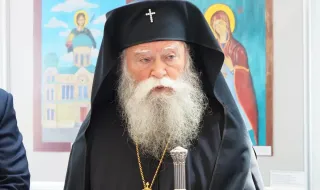
Lovchan Metropolitan Gavriil died early in the morning after a serious illness. The news was announced by the Lovchan Diocese.
“It is with deep sorrow and anguish that we announce that this morning His Eminence Lovchan Metropolitan Gavriil fell asleep in the Lord,” the diocese said in a statement.
On November 4, the Metropolitan was admitted to the Military Medical Academy in Sofia with a diagnosis of acute pancreatitis. No further details about his condition before his death were provided.
His path in the Bulgarian Orthodox Church
Metropolitan Gavriil was born with the secular name Tsvetan Metodiev Dinev on July 16, 1950, in Sofia. His family lived in Czechoslovakia for several years, where he completed his primary education.
In 1984, he graduated from the Saint Kliment Ohridski Theological Academy in Sofia as a part-time student. Later, he specialized at the Moscow Theological Academy and obtained a PhD in theology.
In 2011, he began heading the Cultural and Educational Department of the Holy Synod. On February 8, 2012, he was awarded the title of “honorary member” of the Chamber of Engineers in Investment Design in Bulgaria.
Public positions
In 2019, Metropolitan Gavriil commented on the National Strategy for the Child and stated that he was against physical punishment. According to him, depriving a child of something they love has a better effect than physical punishment.
After anti-epidemic measures were introduced because of the coronavirus, he stated that “the Church has never been a source of infection.” At the end of the same year, the Lovchan Diocese awarded then-Prime Minister Boyko Borissov an order for services to the Church.
In 2023, the Metropolitan also commented on the dispute surrounding the Russian Church in Sofia. At the time, he stated that the church had been built by Russia as an embassy church and had belonged to Russia and the Russian Embassy.