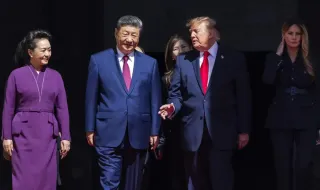
Europe is losing its geopolitical standing after declaring itself a geopolitical player. This was stated by former Deputy Minister of Foreign Affairs and Bulgarian Ambassador to London Lyubomir Kyuchukov on NOVA’s “The Day Live with Nadelina Aneva.”
His comment was related to the meeting between US President Donald Trump, Russian President Vladimir Putin and Chinese leader Xi Jinping. Kyuchukov described the comparison with the 1945 Yalta Conference as misleading. According to him, allies and victors of the Second World War met then, whereas today the countries sitting at the same table are more rivals than allies.
The US, Russia and China are pursuing different interests
According to Kyuchukov, the meeting is part of a deeper process in which the major global powers are increasingly determining the direction of international relations according to their own interests. He believes that Donald Trump was seeking confirmation of the US leadership role and of his own influence over American policy.
According to him, Vladimir Putin’s main objective was to emerge from international isolation and gain China’s support as a partner. Kyuchukov described China as a power that projects itself through international institutions, the rule of law and political dialogue.
The diplomat does not expect the meeting necessarily to mark the beginning of a lasting trilateral format between the US, China and Russia. “They are pursuing different interests,” Kyuchukov said. According to him, interaction between the three countries may continue through bilateral meetings without leading to a permanent trilateral mechanism.
A “deep shadow” over European influence
Kyuchukov described Europe's absence from global processes as political. According to him, Europe is increasingly less often sought out when serious international conflicts are being resolved.
“The conclusion is being forced upon us that, after Europe officially declared itself a geopolitical player, it lost its geopolitical standing,” he said. According to him, the European Union has abandoned the areas in which it was traditionally strong – standards, negotiations, soft power and political decisions.
Kyuchukov also expressed concern over the direction of European security policy. He said that it is focused more on preparing for war than on preventing it, citing as an example recommendations in some European countries that citizens maintain supplies of food and essential goods.
Dispute over military aid to Ukraine
Kyuchukov was particularly critical of the military exercises in Poland organised by the so-called Coalition of the Willing. He raised the question of the relationship between the informal structure and the official institutions of the European Union and NATO.
According to him, the €90 billion loan earmarked for the current and next year is already running out. Kyuchukov said that Ukraine needs approximately another €70 billion, while the European Union has agreed to provide €45 billion through a new joint loan.
Under the scheme he presented, €25 billion will be directed towards military aid, with the guarantees to be provided by the countries in the Coalition of the Willing. The remaining €20 billion is intended for peacebuilding and humanitarian purposes.
This part of the mechanism would allow countries such as Bulgaria to participate without undertaking to finance military aid. Kyuchukov said that Prime Minister Radev had raised the possibility of Bulgaria joining precisely this segment, provided that Bulgaria’s contribution is directed towards supporting ethnic Bulgarians in Ukraine.
Sources: nova.bg