The practice of using former industrial sites to generate energy from renewable sources is widespread in a number of European countries, but in Bulgaria it is hampered by insufficient funding for reclamation, a lack of accessible information about the condition of the sites, and other regulatory and administrative obstacles.
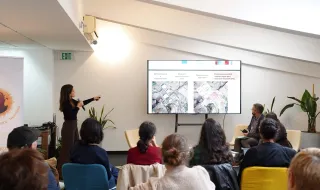
To propose solutions to these problems, on 19 November the environmental association „For the Earth“ organised a round table on the effective reclamation of degraded land. The event was attended by representatives of the Ministry of Environment and Water (MOEW), the Executive Forest Agency (EFA), municipalities, industry organisations from the renewable energy sector, academics, lawyers and civil society organisations, including WWF Bulgaria, the Bulgarian Biodiversity Foundation, „Greenpeace“ - Bulgaria, Bankwatch Network and the Initiative Committee „Let’s Save the Forest of Avren Municipality“.
Successful examples of converting former industrial sites into photovoltaic parks already exist in Bulgaria - a former construction waste landfill in Pernik, a bus depot in Burgas and a former airport in Silistra. According to an analysis by WWF Bulgaria, 233 municipalities in the country have degraded land with the potential to generate solar energy. Their total estimated potential amounts to 28 GW, or more than twice the 13.66 GW target set for 2050 in the Integrated National Energy and Climate Plan (INECP).
Representatives of the renewable energy sector expressed interest in using degraded land, but said they chronically face a lack of funding for reclamation. It often happens that, despite the legal requirement, sites are left without reclamation being carried out to a level that would allow them to be used for the development of solar and wind farms. Land preparation is not covered by funding under projects of the European Bank for Reconstruction and Development (EBRD), which further complicates matters for investors. According to Associate Professor Maria Trifonova, the distance of some sites from the electricity grid may also increase the cost of electricity.
The prospects for financing reclamation activities through European funds during the 2028–2034 period were presented by Daniel Popov of Bankwatch Network. He emphasised the need for early strategic planning, coordination between institutions and the active participation of stakeholders, as future payments will be linked to the achievement of specific targets.
Directing investment towards already disturbed land can reduce pressure on valuable natural habitats, pastures and fertile agricultural land. However, the Bulgarian Biodiversity Foundation stressed the importance of individual assessments and pointed out that not every degraded site is suitable for new industrial activity, as over time some have become refuges for valuable plant and animal species.
Representatives of the Initiative Committee „Let’s Save the Forest of Avren Municipality“ shared their personal experience and drew attention to the insufficient transparency in the selection of sites, the formal participation of local communities and the practice of splitting up investment projects in order to circumvent environmental assessments.
The proposals by „For the Earth“, prepared by lawyer Aleksandar Kodzhabashev, also focused on transparency. They envisage including in the National Concessions Register information on the financial security for reclamation activities, the complete and annual work plans for technical liquidation and conservation, as well as the concessionaires’ annual reports.
It was also proposed to establish a commission involving business and the public to explore the possibilities for publishing the reclamation documentation and the related expert opinions on the website of the Ministry of Energy, in accordance with the principles of the Aarhus Convention.
Balin Balinov of „Greenpeace“ - Bulgaria presented ongoing energy community projects on former degraded sites in Poland, Spain, France and Germany. Such a model allows citizens, municipalities and small businesses to generate energy, so that the profits remain within the community.
„Now that we have specific proposals and an analysis, as well as expressed interest from various stakeholders, we will continue working to overcome the regulatory and technical obstacles and secure support for specific actions,“ said Rumyana Boyanova, the main organiser of the round table from „For the Earth“.