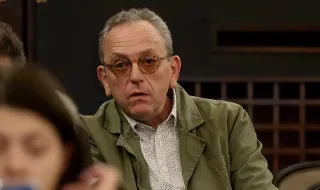
Bulgaria’s demographic crisis is the result of processes accumulated over generations, while depopulated areas cannot be revived merely by buying cheap properties. This was stated by Prof. Petar Stoyanovich on the bTV programme “This Saturday”.
According to the historian, the demographic problem should be among the leading topics in politics. He criticised the lack of a minister directly responsible for measures against depopulation.
“At some point, there are no longer any students for the schools, no workers for the lathes, and no couples left to have children,” Stoyanovich said.
The Rhodopes and Strandzha remain isolated
Stoyanovich pointed to the Rhodopes and Strandzha as regions where the lack of jobs, livelihoods and good infrastructure hinders development. In his words, the situation in the Rhodopes is less severe because of its proximity to Greece, while Strandzha remains more strongly isolated.
As an example of an attempt at state-led revitalisation of the region, he recalled the “Strandzha – Sakar” project from the 1980s. In April 1982, the Politburo of the Bulgarian Communist Party adopted a resolution for the accelerated development of the region by 1990, with around 4,000 workers and specialists planned. A branch of the Bulgarian Academy of Sciences’ Institute of Robotics was also opened in Malko Tarnovo.
However, the project failed to achieve a lasting reversal of the demographic trend. According to Stoyanovich, the reason was that development had been organised artificially, without sufficient sustainable economic and social foundations.
Economic zone near Malko Tarnovo
The historian also commented on Burgas Mayor Dimitar Nikolov’s initiative to establish a free economic zone in the Malko Tarnovo area. The idea envisages a special status for the region, including with regard to customs duties and taxes.
According to Stoyanovich, such a project should combine economic incentives, road infrastructure and nature conservation. He pointed to the region’s proximity to Turkey and Istanbul as an opportunity to attract investment, but stressed that the local population must participate in the area’s development.
Data from the National Statistical Institute show the scale of the problem. As of 31 December 2025, Bulgaria’s population stood at 6,423,207, which is 14,153 fewer people than a year earlier. All regions had a negative natural population growth rate, while 192 populated places had not a single resident.
A chance to slow the decline, but not to stop it
Stoyanovich said that the decline could be slowed by reducing infant mortality, supporting young families and attracting people of Bulgarian descent from North Macedonia, Bessarabia and other regions.
“We have some chance of slowing the trend. It is absolutely impossible to stop it,” the historian said. In his view, restoring depopulated areas requires a long-term policy in which the state, municipalities and private investors act together.
Sources: btvnovinite.bg, bnt.bg