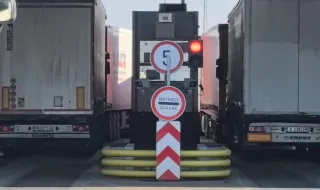
Overloading was the most frequently detected violation during the special inspection operation conducted by the Executive Agency „Automobile Administration“ and the Ministry of Interior. Over the course of two days, 118 heavy goods vehicles were inspected, and 38 reports were drawn up.
Fifteen of the reports were for overloading, accounting for around 40 percent of all violations detected. A violation for which a report was drawn up was found in almost every third inspected truck.
Technical faults and violations of driving-time rules
Another 8 reports were issued for technical faults, while 8 others concerned tachograph violations. Four reports were for the lack of a valid qualification card. Two cases of exceeding the permitted driving time were also detected, as well as one own-account transport operation without the required order.
The inspection checkpoints were selected on the basis of data from the National Toll Administration indicating concentrations of heavy goods vehicles suspected of overloading. In addition to the permissible maximum mass and axle loads, inspectors check technical roadworthiness, tachographs, documents and compliance with driving-time requirements.
Operation began with 17 reports in a single day
At the beginning of the operation, on November 27, 54 heavy goods vehicles were inspected, 31 of them „gondola“-type trucks used to transport grain. Seventeen reports were drawn up at the time, including 7 for overloading, 4 for technical faults, 4 for tachograph violations, one for failure to comply with driving-time requirements and one for the lack of a valid qualification card.
The inspections are part of measures to step up control over heavy goods transport, discussed by the institutions responsible for road safety. According to the Ministry of Transport and Communications, the aim is to reduce risks to traffic and the negative impact of overloaded vehicles on road infrastructure.
„Through the joint actions of the Executive Agency „Automobile Administration“ and the Ministry of Interior, we are sending a clear signal that enforcement will be uncompromising. Our responsibility as institutions is to ensure compliance with the rules, while carriers are responsible for preventing violations. Safety is not subject to negotiation and cannot be a matter of economic expediency,“ said Minister of Transport and Communications Georgi Peev.Enhanced controls on heavy goods vehicles are continuing against the backdrop of planned use of data from the toll system and other registers to target inspections at vehicles posing a higher risk of violations. In August, during a separate inspection in Plovdiv Region, one of 10 inspected trucks was found to be carrying around two tonnes above the permissible weight.
Sources: bta.bg