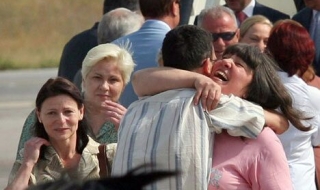
On July 24, 2007, Libya released Bulgarian medics Kristiana Valcheva, Nasya Nenova, Valentina Siropulo, Valya Chervenyashka and Snezhana Dimitrova, along with Kristiana's husband Dr. Zdravko Georgiev and Palestinian medical student Ashraf Hadjouj. They spent more than eight years in Libyan prisons.
Our medics arrived in Sofia on the government plane of the French Republic, accompanied by the then wife of the French President Cecilia Sarkozy. Diplomatic reports sent to the State Department from Sofia, provided by Wikileaks, reveal some details unknown to the public from the negotiation process that led to the final “deal” for the medics.
The US prefers quiet diplomacy for the release of the Bulgarian nurses in Libya, it is clear from the cables. The Bulgarian side, for its part, believes that the Americans are the only force with enough influence to convince Libya to make the “difficult political decision“ to release the nurses.
Bulgarian Foreign Minister Ivailo Kalfin told US Ambassador Byerly in March 2006 that Bulgaria had thrice prevented the Council of Europe from issuing a resolution on the Bulgarian nurses sentenced to death in Libya in order to encourage “a productive atmosphere for negotiations”. However, he stressed that such a position cannot be maintained indefinitely.
However, the conclusion of the deal for the medics became effective after Bulgaria forgave the Libyan debt of 56.635 million dollars on August 2.
The nurses Kristiana Valcheva, Nasya Nenova, Valentina Siropulo, Valya Chervenyashka and Snezhana Dimitrova, together with Kristiana's husband, Dr. Zdravko Georgiev, and Palestinian medical student Ashraf Hadjuj, were arrested in Benghazi on February 9, 1999 and remained in Libyan prisons for a total of 2,755 days.
They were accused in 2000 of deliberately causing an AIDS epidemic in Benghazi with the aim of destabilizing the Jamahiriya.
Two more Bulgarian citizens - Emanuela Koleva and Smilyan Tachev - were also brought to the trial in absentia, accused together with the main group of defendants in violation of Libya's moral norms and currency laws.
In 2002, the doctors were acquitted on charges of conspiracy against the state, but an intermediate court preserved and continued the case on the remaining charges - intent, poisoning, adultery, alcohol use, illegal currency transfers. On May 6, 2004, the nurses and Ashraf received death sentences by firing squad. Zdravko Georgiev was convicted only on the lesser charges, as were Koleva and Tachev, who had left Libya before the start of the trial.
In 2005, the Supreme Court of Libya overturned the death sentences and returned the case for a new trial. In 2006, the sentences were reaffirmed by the Court of Appeal, and on July 11, 2007 - finally confirmed by the Supreme Court.
On July 17, 2007, the death sentences of the Bulgarians were commuted to life imprisonment by the Supreme Judicial Council of Libya. In June 2007, Ashraf Hajouj's application to receive Bulgarian citizenship was granted.