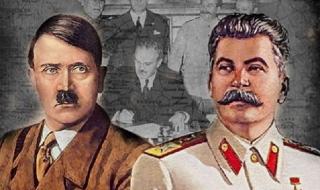
On September 1, 1939, Adolf Hitler invades Poland. The attack began on the evening of August 31, 1939, when a group of armed SS men stormed the radio station building in the German city of Gleiwitz, which was on the border with Poland at that time. Firing several shots into the microphone, the Hitlerites read a previously composed text in Polish, which contained a call for war by Poland against Germany. To further mislead the German people, Hitler staged similar "attacks" in other parts of the German-Polish border. Soon after, German radio stations broadcast emergency reports about an alleged attack by the Poles on German territory. As evidence, corpses of "Polish soldiers" were displayed, who were actually shot by the SS German criminals taken from the prisons of the Third Reich.
This disgusting move to "attack" the Poles overturned the cup of "German patience" and Hitler gave the order to attack. The Polish army, which was not ready for the attack, faced the German army without anti-tank guns and tank divisions and was literally swept away by the decisive superiority in the breakthrough area. This was the beginning of World War II. England and France, linked to Poland by allied treaties, declared war on Germany on September 3, 1939. The same day, Australia and India joined the war, and a week later, Canada. In early October, the last Polish soldiers surrendered and Warsaw fell under German command. By decree of the fascist government of October 8, the western regions of the country were declared "German lands" and annexed to the Third Reich. The remaining territory of Poland occupied by the Nazis began to be called "General Government".
From the moment the German-Polish war began until the spring of 1940, England and France, on the one hand, and Germany, on the other, did not actually conduct military operations in Western Europe. Legally, these countries were in a state of war, there was a front where huge military contingents were concentrated, but there was peace. This situation remained in history under the name "Strange War". This name comes from the French language, but it has a different meaning when translated from German - "comic war".
"Strange War" ended on April 9, 1940 with the German invasion of Denmark and Norway without warning.
But let's go back to mid-September 1939. The USSR began to implement the agreements of the Molotov-Ribbentrop Pact signed in August 1939. On September 17, 1939, after the defeat of the Polish army by the Germans and the fall of the Polish government, the Red Army entered Western Belarus and Western Ukraine.
On September 28, 1939, the Treaty of Friendship and Borders between the USSR and Germany was signed by the foreign ministers of both countries, Vyacheslav Molotov and Joachim von Ribbentrop, which recognized the destruction of the independent Polish state.
According to the treaty, a border was established between Germany and the USSR on the territory of the former Polish state, which was final and both sides undertook not to allow interference by third countries. This border was seen as the basis for the development of future friendly relations between the two countries. The treaty and its secret protocols were a consequence of the Molotov-Ribbentrop Pact and effectively provided Germany with a rear area.
According to the signed secret protocol, Western Belarus and Western Ukraine became part of the Soviet Union. At the same time, the USSR insisted on signing agreements with Estonia, Latvia and Lithuania, according to which it would receive the right to introduce its troops into their territories. After this was done, elections were held in these republics for legislative bodies, which were won by the communist forces. In 1940, Estonia, Latvia, and Lithuania became part of the USSR.
Through the Soviet-German treaties of 1939, including the Molotov-Ribbentrop Pact, Nazi Germany and the USSR divided their spheres of influence in Europe, according to which at the beginning of World War II, Western Ukraine and Western Belarus were included in the USSR, and in 1940, the Baltic States, Bessarabia (Moldova), and Northern Bukovina.
As a result of all these actions, significant territories with a population of 14 million people were included in the USSR. The country's border was moved westward in various places at a distance of 300 to 600 km.
The clock for the "Barbarossa" plan began to tick.