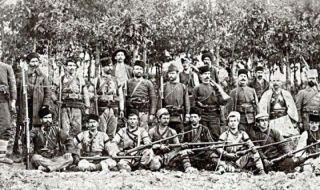
On October 5, 1878, the Kresna-Razlog Uprising broke out.
It was caused by the decisions of the Berlin Congress, which divided the newly liberated Bulgarian lands.
The Bulgarians from Macedonia sent petitions, memoirs and requests to the governments of the Great Powers and the Provisional Russian Administration, with which they protested against the decision that their lands should remain within the borders of the Ottoman Empire.
There was no response, and for this reason the Macedonian Bulgarians rebelled against the Ottoman authorities in order to join the Principality of Bulgaria.
On October 5, a combined detachment of about 400 insurgents, divided into detachments, under the general command of Stoyan Karastoilov (Stoyan Voivoda) and Adam Kalmikov attacked the Turkish garrison located at the Kresna khans. After an 18-hour battle, the Turkish army surrendered. 119 soldiers and two officers were captured.
A number of villages were liberated. In addition to the Kresna Gorge, insurgent actions began in the Nevrokop, Demirhisar, Ser, Maleshevo and other regions. In early November, the uprising also covered the villages of the Razlog Valley. But despite the heroism shown, the Turks went on the offensive. On November 11, 1878, Kresna was burned. The same fate befell another 12 villages from the Kresna Gorge. Towards the end of November, the uprising in Razlog was also crushed.
However, on the right bank of the Struma River, the insurgent actions continued until February 1879, but the split in the leadership had a strong negative result.
On May 25, 1879, Nathanael Ohridski disbanded the detachments and the uprising was ended.
The brutality of the Turkish army and the Bashibozuk against the population forced over 25,000 people from Melnik, Gorno-Dzhumaj, Razlog and other parts of Macedonia to leave their native villages and seek refuge in the Principality of Bulgaria.
Officially, Russia distanced itself from the uprising, but the middle and lower levels of the administration of the provisional Russian government in Bulgaria, however, supported the rebellion. The other Great Powers, represented by Great Britain and Austria-Hungary, were against it.