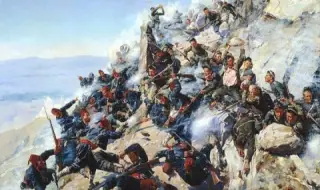
On August 8, 1877, General Stoletov sent an alarming telegram to General Radetzky.
This is recalled by InfoSpravka.com.
The telegram reads:
„ I bring you unmistakably that the entire corps of Suleiman Pasha, which we see as if in the palm of our hand, is turning against us eight versts from Shipka. The enemy's forces are enormous. I say this without exaggeration, we will defend ourselves to the extreme, but reinforcements are desperately needed."
Only 7,500 Russian soldiers and Bulgarian militia with 27 guns against 27,000 Turkish soldiers with 48 guns. The Russian soldiers and the Bulgarian militia brought the much-desired freedom to the Bulgarians after 500 years of Ottoman rule.
After the battles at Stara Zagora, the Central Ottoman Army under commander Suleiman Pasha headed north to cross the Balkan Mountains. The goal was to break through the blockade at the city of Pleven and join up with the units of the Western Army and the East Danube Army in the Ruse – Shumen – Varna – quadrangle. Silistra.
If the Central Ottoman Army manages to cross the Balkan Mountains, it will put the Russian Army in a critical position and the final outcome of the war remains uncertain.
On August 7, the concentration of the Central Ottoman Army near the city of Kazanlak was discovered. On August 8, Major General Stoletov sent a telegram to Lieutenant General Radetsky, which read:
“ I report without error that the entire corps of Suleiman Pasha, which we see as if in the palm of our hand, is turning against us eight versts from Shipka. The enemy's forces are enormous. I say this without exaggeration, we will defend ourselves to the extreme, but reinforcements are desperately needed."
Reinforcements are being sent to help with an accelerated march. It takes three days for them to arrive. On August 9, the heroic battle of Shipka began.
During the night of August 8 to 9, units of Rejeb Pasha's column moved towards the peak of Malak Bedek and at around 7:00 a.m. they repelled the Russian posts, built a position and deployed a battery. At around 8:00 a.m. they attacked the Russian positions on the peak of Sveti Nikola. The attack was repelled by the infantry and the Steel Battery.
Major General Stoletov assessed the actions as the beginning of the main blow and supported the forces of Colonel Tolstoy with the entire infantry reserve of the Shipka detachment (three companies of Orlov and eight companies of the militia). At around 9:00 a.m., Shakir Pasha's column attacked Orlovo Gnesdo. He violated the order to conduct only demonstrative fire and launched a frontal attack against the first Russian position (main) in the area of the Malak Battery. The attack was repelled, but Ottoman units dug in 150-200 meters from the position and conducted intensive fire. The situation created gave reason for the Field Headquarters of the Russian Army to send a message to all units:
„ Shipka is being heavily attacked by the army of Suleiman Pasha. The attack began in the morning. The battle is in full swing. The attack is being conducted along the front, bypassing both flanks. The situation is critical. “
The units of the VIII Army Corps sent as reinforcements are urged to move as quickly as possible. Around 13:00, the column of Rejep Pasha launched its fourth attack against the Steel Battery, and from the flank it attacked the column of Shakir Pasha for the fifth time. In the midst of the battle, reinforcements arrived with a rapid march, the XXXV Bryansk Infantry Regiment (commander, Colonel Alexander Lipinsky), which took over the defense of the western and northern positions. Three more Turkish attacks were repelled, with the defenders, due to a lack of ammunition, using stones, trees and even the corpses of the dead.
On this occasion, Lieutenant General Radetzky stated to the war correspondent of the French newspaper “L'Estafette“, A. M. Mlohovsky de Belina:
“ You write mainly about my brave regiments and the valiant Bulgarian militia, which, lacking ammunition, repelled the Turkish attacks with stones. “
Around 18:00, the defenders of the pass held out and the attacks were stopped. The Ottoman forces occupied advantageous positions for an attack on Mount Malak Bedek, Mount Demirtepe and Mount Demievets.
The next day, August 10, Suleiman Pasha canceled the order for a new attack. He organized detailed reconnaissance and developed a plan of action for the next day. The Ottoman forces prepared the occupied starting positions with engineers. They installed new artillery batteries on the first site under Orlovo Gnesto. The battery on Mount Malak Bedek was expanded to 8 guns. The defenders from the Shipka detachment regrouped and dug in. An artillery exchange was conducted intermittently throughout the day. The lull allowed time to be gained for the Russian reinforcements to advance to the Shipka Pass.
The Turkish attacks on August 11 began at around 4:00 AM, with the directions of the attacks changed. Rasim Pasha attacked Mount Uzunkuş and Mount Küçük Yesiltepe in two columns. Salih Pasha's column attacked Mount Sveti Nikola, and the general reserve attacked Mount Akri Jebel. Veysel Pasha made a surprise attack on the eastern position at around 9:00 AM. By noon, all attacks were repelled. The situation became critical at around 4:00 PM when the Ottoman forces captured Mount Küçük Yesiltepe, and Mount Uzunkuş was heavily attacked. Two companies of Bulgarian militia repelled the attack. The retreat to Mount Küçük Yesiltepe was perceived by individual commanders as a permitted retreat.
The catastrophe was prevented by the decisive intervention of the middle command staff: Colonel Lipinski with 20 soldiers stopped the retreat in the area of the circular battery, Colonel De-Preradovich held the composition of the circular battery, Major Chilyaev returned the volunteers to the eastern positions, Staff Captain Polikarpov held the staff of the central battery, and Doctor Konstantin Vezenkov (senior doctor of the Bulgarian Volunteers) organized a counterattack with the forces of the wounded who could move.
At 17:30, the first reinforcements arrived at Mount Shipka, the company of Lieutenant Buffalo, two soldiers on artillery horses from the XVI Rifle Battalion of the IV Rifle Brigade (the Iron Brigade, commander, Major General Adam Tsvetsinski). By 18:00 the battalion concentrated, attacked, ensnared units from the XXXVI- Orlovsky and XXXV- Bryansk Infantry Regiments and captured the peak of Küçük Yesiltepe. The 2nd Rifle Brigade from the 14th Infantry Division (commander Major General Mikhail Dragomirov) also arrived. The positions were stabilized and by 22:00 the decisive battle died down along the entire line.
Suleiman Pasha in a report to the Headquarters concluded:
„ Such a cruel and bloody battle has never been seen. “
Assessing the fighting qualities displayed on August 11 by the Bulgarian Volunteers, its commander, Major General Nikolay Stoletov, in a telegram to the Chief of the Field Staff, Lieutenant General Artur Nepokojchytsky, stated:
„ As for the Bulgarians, they will not be afraid even if we use them up to the last man. “
A few days later he insisted:
„ They should be rewarded, as is established for the units of the troops of our army. “
On the morning of August 12, the command of the Shipka detachment, reinforced with new reinforcements to 14,820 soldiers, was taken over by Lieutenant General Fyodor Radetsky (commander of the Southern Detachment).
He intended to improve his positions by taking action against the commanding heights occupied by the Ottoman forces. Suleiman Pasha was unaware of the change in the Russian forces and renewed the attacks, the main target of which was their rear area. The offensive began with the column of Veysel Pasha in the area of the road to the city of Gabrovo. The XII Rifle Battalion (Major Klimovich) repelled three Turkish attacks. The column of Shakir Pasha subjected the positions on Mount Sveti Nikola to fierce but unsuccessful shelling from the east, and Salih Pasha attacked the peak from the south. The XXXVI Oryol Infantry Regiment repulsed him. The most fierce battle was from the west against the second group of fortifications, attacked by Rasim Pasha's column. The 16th Rifle Battalion (Lieutenant Colonel Khodyakov) defended the peak of Küçük Yesiltepe. At the peak of Uzunkush, the commander of the 14th Infantry Division, Major General Mikhail Dragomirov, was wounded. Its command was taken over by Major General Mikhail Petrushevsky. At around 2:00 p.m., Lieutenant Colonel Khodyakov unsuccessfully attacked Yesiltepe.
1,000 civilians from the city of Gabrovo, sent to the positions by Lieutenant General Viktor Krenke, also participated in the fighting. The military correspondent of the English newspaper “Daily News“, Archibald Forbes, testified about their contribution to the Russian diplomat Count Nikolai Ignatiev:
“ He is delighted with our soldiers, and also praises the Bulgarian volunteers. Moreover, 1000 residents and children of Gabrovo carried water to our troops and even to the first-line riflemen under a hail of bullets, and also carried out the wounded with complete self-sacrifice. “
By 22:00 the battle ended and the opponents returned to their starting positions.
On August 13, the composition of the Shipka detachment regrouped. The Bulgarian volunteers were withdrawn to recover and rearm in Gabrovo. With the newly arrived 53rd Volyn Infantry Regiment, the Russian forces reached 14,217 soldiers and 44 guns. The fight was to push the Ottoman forces from the Akri Dzhebel peak and the Yesiltepe peak to their starting positions. Around 7:00, the column of Lieutenant Colonel Lipinsky (35th Bryansk, 56th Zhytomyr and 54th Podolsk Infantry Regiments) captured Yeshiltepe Peak. It attacked Akri Jebel Peak from the move, but was repulsed by Veysel Pasha's column. Shakir Pasha's column unsuccessfully counterattacked Yeshiltepe Peak. Major General Valerian Derozinsky, commander of the Russian Gabrovo Detachment, was killed on Uzunkush Peak.
On August 14, Shakir Pasha's column renewed the offensive against Mount Yesiltepe. After flanking it, the Russian forces withdrew to Mount Küçük Yesiltepe. By the end of the day, both sides had exhausted their offensive forces and were moving to defense. The six-day battle for the Shipka Pass ended.
On the Ottoman side, total killed and wounded: 223 officers and 6,527 soldiers.
The Bulgarian and Russian soldiers who fell for the freedom of Bulgaria after the battles of Shipka, total killed and wounded were: 108 officers and 3,348 soldiers.