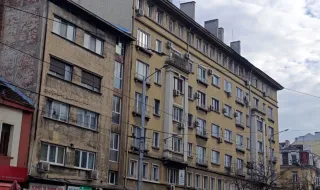
The aging of the housing stock in Sofia is gradually becoming one of the factors that support the demand for new construction. More and more owners are looking for a way to replace their old apartment with a newer, more functional and energy-efficient home, and the trend may have a long-term impact on the capital's real estate market.
Data from the census of the National Statistical Institute show that over half of the homes in Bulgaria were built before 1990. In Sofia, a significant part of the housing base was built during the decades of mass panel and large-scale formwork construction.
Nearly 37% of the capital's housing stock is panel or EPC construction that is more than three decades old. It is this huge volume of existing homes that can gradually generate new demand.
It is not so much about the physical suitability of old buildings, but about the changing requirements of households. Buyers are increasingly comparing old apartments with new construction in terms of indicators such as energy efficiency, room layout, heating, parking, common areas and overall environment.
Every fifth client replaces an old home with a new one
The trend is already noticeable in real transactions. About 20% of the company's clients replace an old home with a new one. The segment does not yet dominate the market, but its importance is expected to grow in the coming years.
The requirements for the living space itself are also changing. If 15-20 years ago, bedrooms of 8-9 sq m were an acceptable architectural solution, today some buyers are looking for significantly more spacious premises. In the projects that Vassilev is talking about, the bedrooms, for example, are around 15-16 sq m, and the living rooms with dining rooms - between 24 and 28 sq m.
The pandemic has further changed the attitude towards home. Remote work has increased the importance of an extra room, a larger living room, a terrace or a yard. Thus, when choosing, it is increasingly important not just how many square meters are purchased, but how they can be used.
Deals are decreasing, mortgages continue to grow
Market indicators also signal a change in the profile of buyers. According to data from the Registry Agency, cited in the analysis, in the first quarter of 2026, 7,529 property transactions were registered in Sofia - 12.3% less on an annual basis. At the same time, contractual mortgages reached 3,948 and increased by 1.7%.
This may be an indication of a more cautious market, in which part of the speculative demand is weakening, while people who buy for their own use remain active.
Construction activity also remains high. In the first quarter of 2026 alone, permits were issued in Sofia for 265 residential buildings with a total of 3,948 homes and over 602,000 sq m of gross floor area. The number of homes in the issued permits is 2.2% higher than in the previous quarter, and their planned area has increased by nearly 20%. This is shown by official NSI data.
Over 82% of Bulgarians live in their own homes
The specifics of the Bulgarian market also support this trend. Over 82% of the population lives in their own homes, according to Eurostat data cited in the analysis. This means that a significant portion of the future clients of construction companies may not be people who are just acquiring their first property.
Instead, households that already have their own apartment but want to sell it and move to a newer home may become an increasingly important group.
In parallel with new construction, there is also the issue of renovating existing buildings. The updated plan of the Sofia Municipality includes a phased energy renovation of the housing stock, with the total developed built-up area of the renovated homes to reach around 3 million sq. m. The measures include insulation, replacement of window frames, modernization of heating systems and integration of renewable energy sources.
Thus, two parallel processes are taking shape in the market – modernizing part of the existing housing stock and gradually moving other households to new construction.
The aging of buildings may therefore be a factor with a much longer horizon than the movement of mortgage rates or short-term fluctuations in the number of transactions. Even in a slower market, the need for more functional, energy-efficient and modern lifestyle-friendly housing will not disappear - and it is this that can sustain the demand for new construction in Sofia in the coming years.
Detailed statistics on average property prices in Bulgaria by city and neighborhood can be found at imot.bg