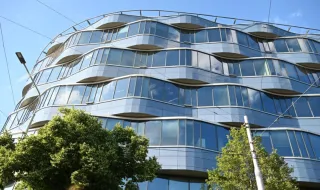
The Prague office market remains tight, with vacancy rates falling to 5.65% in the third quarter of 2026. This is a decline of 11 basis points quarter-on-quarter and 74 basis points year-on-year, according to data from Prague Research Forum.
The total volume of modern office space in the Czech capital reaches approximately 3.95 million sq m, with no new projects completed in the third quarter. Vacancy is around 222,900 sq m.
However, there are significant differences between the different areas of the city. The highest vacancy rates are in Prague 10 – 12%, and Prague 3 – 11.1%. In the central parts, the vacancy rates are significantly lower – only 1.2% in Prague 2 and 3.6% in Prague 1.
There are approximately 308,900 sq m of office space under construction in Prague, which is 27% more than a year earlier. Construction is mainly concentrated in Prague 5, where 39% of the new space is located, and Prague 4 with a share of 36%.
However, a significant part of the future supply has already been taken. About 61% of the offices under construction have secured tenants, which further limits the amount of new space that will actually come onto the free market. About 73% of the existing modern office stock is in classes A to AAA.
The shortage of quality space is also putting pressure on prices. Rents for prime offices in the center of Prague are already reaching 31-32 EUR/sq m per month, and in inner city areas - 22.50-23.50 EUR/sq m. On the periphery, the levels remain between 16 and 17 EUR/sq m per month.
Despite the low vacancy rate, companies remain cautious about moving into new offices. The total volume of leased and renegotiated space in the third quarter was 107,000 sq m, which is 41% less year-on-year. More than half - 53% are renegotiations of existing contracts, while new leases account for 30%.
The largest announced deal for the quarter is the renegotiation of Microsoft's contract for 12,800 sq m in the Delta building in the Brumlovka complex. Other major deals include those of Adastra for 5,300 sq m and NET4GAS for 4,700 sq m.
Technology companies are the most active tenants and form 28% of the demand, followed by the pharmaceutical and healthcare sectors with 11% and professional services companies with 10%.
According to Pavel Novak, Head of “Office Space“ at Savills, low vacancy and rising rents at first glance indicate a strong market, but the structure of the deals paints a different picture. More and more companies prefer to stay in their current offices and renegotiate their contracts rather than move.
Thus, the Prague market finds itself in an unusual situation - new construction is growing, vacant quality offices are decreasing and rents are increasing, but activity in concluding completely new contracts is weakening.
Detailed statistics on average property prices in Bulgaria by cities and neighborhoods can be seen at imot.bg