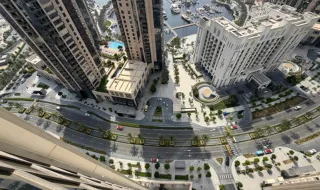
Dubai and Abu Dhabi’s real estate markets could recover in 2027 if political losses by President Donald Trump’s Republican Party in the U.S. midterm elections contribute to ending the war with Iran. Such a scenario would stimulate foreign investment and support housing prices in the United Arab Emirates (UAE), the South China Morning Post reports, citing industry analysts.
The military conflict, which began in February with U.S. and Israeli strikes against Iran, led to a significant cooling of the region’s property market. According to consultancy JLL, the number of residential property transactions in Dubai fell by 37.7% year-on-year in the third quarter of 2026, while Abu Dhabi recorded a decline of 9.6%.
Prices have also declined. In Abu Dhabi, townhouses became 8.3% cheaper compared with the previous quarter, while in Dubai apartment and villa prices fell by 1.8% and 1.6%, respectively.
Kashif Ansari, co-founder and chief executive officer of international real estate platform Juwai IQI, predicts that foreign buyers will return in greater numbers once the geopolitical situation stabilizes.
According to him, it is still too early to expect the results of the U.S. congressional elections to lead to an immediate change in American foreign policy. Nevertheless, the company maintains its positive outlook for housing prices in Dubai and the rest of the Middle East in 2027.
Uncertainty is already affecting the luxury segment as well. Between 2023 and 2025, Dubai was the world’s leading market by the number of homes sold for more than $10 million, surpassing Hong Kong, London and New York.
In the third quarter of 2026, however, Hong Kong overtook the emirate in terms of the total value of transactions in this segment. According to Knight Frank, 78 sales worth $1.58 billion were completed in the Asian financial center, while Dubai recorded 86 transactions totaling $1.57 billion.
Despite the decline, analysts believe that the main factors attracting investors to the UAE remain unchanged. These include the favorable tax regime, opportunities for long-term residence through the so-called golden visa program, rental yields and the strategic location between Europe and Asia.
Dubai’s growing population, which has now reached 4.73 million people, is providing additional support to the housing market. A total of 242,500 rental contracts were signed in the third quarter alone, Ansari notes.
According to Felix Cheung, head of JLL’s international residential segment for Hong Kong, the UAE real estate market is going through a period of normalization after several years of record growth. Demand remains relatively resilient, but the pace of growth in housing prices and rents is slowing.
Meanwhile, rating agency S&P Global Ratings warns that the continuation of the regional conflict in 2027, combined with the expected increase in the supply of new homes, could intensify pressure on prices, particularly in the segment of apartments purchased for investment purposes.
However, once security is restored, analysts expect the market to gradually stabilize and international capital to return.
According to Juwai IQI, the main question is no longer whether foreign investment will recover, but when this will happen – in the first, third or one of the subsequent quarters of 2027.
Detailed statistics on average property prices in Bulgaria by city and neighborhood can be found at imot.bg