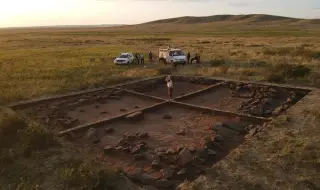
In the Bukhar-Zhyrau region (Kazakhstan), archaeologists from the Karaganda University “E.A. Buketov“ discovered the remains of an ancient dwelling dating back to the Bronze Age.
The unique find was made near the village of Tortkol – is a semi-dugout with a double row of walls built of stone slabs.
Inside the building, scientists found fragments of clay pottery with geometric patterns, animal bones, stone tools, a flint arrowhead and a metal knife.
According to experts, based on the ceramic complex and architectural features, the find can be attributed to the Alakul archaeological culture and dates back to the 18th-17th centuries BC.
"We plan to conduct a technical and technological analysis of the pottery and send samples for radiocarbon dating to clarify the chronological framework. The study of such monuments allows us to better understand the life and economic life of the ancient inhabitants of Central Kazakhstan," said Alexey Kukushkin, director of the Saryarka Archaeological Institute.
Earlier it was reported that in the Nurinsky district, members of the expedition of the Karaganda Research University named after E. A. Buketov have discovered the grave of a child who probably lived more than a thousand years ago.
The news was published based on an information exchange agreement between Fakti.bg and Kazinform
Detailed statistics on average property prices in Bulgaria by city and neighborhood can be seen HERE