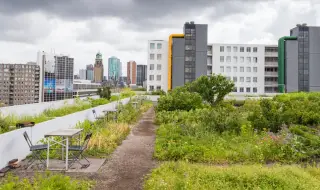
Migration from smaller populated areas to large cities and global warming are the two factors that have radically changed the life of today's people. The house with the large yard, where organic fruits and vegetables are grown and everything is preserved for the winter, is already a thing of the past. Today, it is fashionable to have a garden literally on the roof of the residential building - something that until recently seemed like science fiction. We can already see such in Tokyo, New York and Singapore - cities that are literally suffocating from overpopulation and overdevelopment.
Roоof farming is a method of growing plants based on the hydroponic method. In it, plants develop without soil, but in nutrient-rich water. The system is installed directly on flat roofs of multi-story buildings. The construction is lightweight so as not to compromise the stability of the building.
In the United States today, there are nearly half a trillion roof spaces in areas with a population of over 50,000 people. Since 2010, urban rooftop agriculture has been growing by 25% every year - a pace that is not to be ignored.
Most existing flat roofs are strong enough to withstand the infrastructure of Roof farming, say specialists from the company Green Roofs for Healthy Cities.
The use of direct sunlight is the main advantage of Roof farming. Its presence practically eliminates the need for artificial lighting and from this point of view makes the method extremely energy efficient. Also, the irrigation system is designed to make maximum use of rainwater. This eliminates the need to install complex irrigation systems and waste water.
A big plus of the installation of Rооf fаrmіng is the reduction of the building's heat load. The system acts as a natural insulator and protects the building from additional heating and a corresponding increase in the temperature in the rooms.
Detailed statistics on the average prices of properties in Bulgaria by cities and neighborhoods can be seen HERE