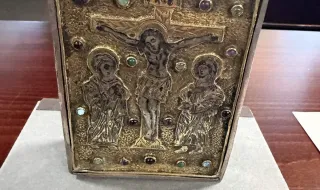
A 17th-century reliquary stolen from the Bachkovo Monastery was listed for sale in Estonia for €15,000. The relic has been returned to Bulgaria after Bulgarian authorities discovered that photographs of the item had been published on an Estonian online auction website.
The valuation used for the auction was between €20,000 and €25,000. This was announced by Anna Vikova, deputy district prosecutor of Plovdiv. According to bTV, the reliquary was offered at a price below the stated valuation.
The trail emerges in May
The relic disappeared from the Bachkovo Monastery in 1999 along with seven other church artifacts. Its fate remained unknown until May 2026, when photographs of the reliquary were discovered in the Estonian listing.
After establishing that the item had been offered for sale, Bulgarian authorities alerted their Estonian counterparts. This led to the sale being halted and the valuable object being returned to Bulgaria.
New pre-trial investigation
The initial investigation into the theft was terminated in 2019 because the statute of limitations had expired. After the reliquary was discovered in Estonia, a new urgent pre-trial investigation was launched.
„Because the statute of limitations has expired, a new urgent pre-trial investigation must be launched,“ explained Chief Inspector Danail Kolev, head of the Asenovgrad District Police Department.The available information does not make clear whether anyone has been detained or charged in connection with the case. The investigation must establish how the relic left Bulgaria and how it reached the Estonian market.
A relic dating from 1645
Historical records indicate that the reliquary was made in 1645 with funds provided by the hieromonk and former abbot Matey. It was kept at the Bachkovo Monastery for centuries. It is believed to have held the relics of Saint Kyriakos.
The return of the item ends more than a quarter-century of uncertainty surrounding its fate and restores part of the cultural and religious heritage taken from the monastery.