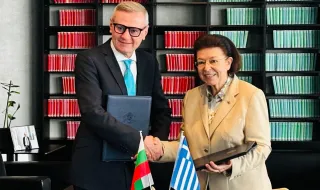
Bulgaria will provide Greece with 48 church and historical relics in exchange for the remains identified as belonging to Tsar Samuil. This is recorded in a memorandum of understanding signed between the ministers of culture of the two countries.
The relics are associated with three Greek church institutions - the monastery of “Panagia Ikosifinissa“ in the Drama region, the monastery of “St. John the Baptist“ near Serres and the Holy Metropolis of Serres and Nigrita. They were brought to Bulgaria in 1917, during the First World War.
What objects are being returned
The publicly described objects include church utensils, reliquaries and gospel bindings. BNT quotes the Minister of Education Krasimir Valchev, according to whom these are mainly objects of religious and cultural value, which after an exhibition at the Museum of Byzantine Culture in Thessaloniki will be returned to the respective monasteries and the metropolitanate.
There are differences in public statements about the content of the list. NOVA reported that there are no manuscripts among the transferred values. However, historian Prof. Hristo Matanov pointed out that the Gospel of John Kantakouzenos with annotations was also discussed in the negotiations. The full list of names of the 48 items has not been published in official announcements.
Minister of Culture Evtim Miloshev defined the agreement not as a commercial transaction, but as an “exchange of artifacts from our side and the relics of the Bulgarian Tsar Samuil“. According to him, the value of the two sides of the agreement cannot be compared on a market basis.
What Bulgaria receives
Greece will hand over to Bulgaria the remains identified as those of Tsar Samuil, as well as anthropological material from other sarcophagi in the “Saint Achilles“ basilica. Some of these remains are believed to belong to Tsar Gavril Radomir and other members of the royal family.
The remains were discovered during archaeological excavations on the island of Saint Achilles in the Small Prespa Lake. There is a discrepancy between the sources regarding the year of discovery: official announcements and Greek publications indicate 1965, while BNT indicates 1969. The discoverer is the Greek archaeologist Nikolaos Moutsopoulos.
Prof. Kazimir Popkonstantinov told bTV that Greece is handing over not only the remains of Samuil, but also those of his relatives. Historian Prof. Hristo Matanov pointed out that, in his opinion, the high degree of certainty for the identification of Samuil is also supported by traces of trauma to the hand described in medieval accounts of the ruler.
When will the remains return
The official ceremony will be on October 3 at the Museum of Byzantine Culture in Thessaloniki with the participation of Bulgarian Prime Minister Rumen Radev and Greek Prime Minister Kyriakos Mitsotakis.
The remains will then be transported to Sofia and placed in a special sarcophagus in the church of “Saint Sophia“. Rumen Radev invited citizens to “Batenberg“ Square on October 3 at 12:30, from where the welcome and procession to the temple will begin.
According to the Greek publication “Kathimerini“ negotiations were resumed in 2019-2020 after a long break, and were accelerated in 2026. Thus, after decades of talks, the two countries agreed on the simultaneous transfer of the remains of the medieval ruler and the 48 relics associated with Greek monasteries.
Sources: Kathimerini, BNT, NOVA