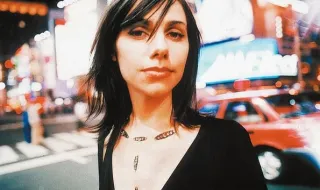
The first sound that PJ Harvey associates with her childhood came not from a studio, but from Dorset. Born Polly Jean Harvey on October 9, 1969 in Bridport, she grew up on a farm near Corscombe, in a family that listened to the blues, Bob Dylan and Captain Beefheart. At 57, the British musician continues to change direction, without completely repeating any of her previous images.
From sculpture to guitar
Before music became her profession, Harvey studied sculpture at Central Saint Martins College in London. In 1988, she joined the band Automatic Dlamini, where she played and sang with John Parish. Their collaboration lasted for decades and became one of the most important constants in her work.
In 1991, she created the trio PJ Harvey with Rob Ellis and Ian Oliver. The name originally denoted a group, not a solo project. The debut Dry from 1992 was short, sharp and devoid of unnecessary embellishment. The next Rid of Me from 1993 expanded this sound with heavier guitars and tension, which made her voice the main instrument.
Albums as different faces
With To Bring You My Love from 1995, Harvey moved away from the trio formula and built a darker, theatrical and bluesy world. It also featured the song Down by the Water, one of the most recognizable recordings of her career. This was followed by dramatic changes in sound – electronic textures, piano, autoclavier, folk motifs and songs dedicated to war, history and personal memory.
Her 2000 album Stories from the City, Stories from the Sea won her first Mercury Prize in 2001. With it, Harvey became the first woman to win the award. Ten years later, Let England Shake brought her a second victory – an achievement that made her the only two-time winner of the prize. I Inside the Old Year Dying, released in 2023, is her tenth studio album.
„As a creative artist, it is important to remain open – to feel. "You can't work with a closed heart," Harvey told the Guardian.Music beyond albums
Harvey also writes music for theatre, film and television. In 2025, she and composer Tim Phillips won a BAFTA television award for the score for the second season of Bad Sisters. Her work thus expanded beyond her role as a singer-songwriter – to composition, sound narration and image work.
Her latest move comes from an unexpected direction again. In June 2026, Voyager was released – a song related to the space probes “Voyager“. It features physicist Brian Cox and composer Dario Marianelli. Harvey explains that she was drawn to the challenge of writing a song in the voice of “Voyager 2“.
That remains the most characteristic of PJ Harvey's path - she does not use her past as a ready-made formula. At one time she sounds like a raw rock musician, at another - a writer of historical songs, and today she can speak on behalf of a spacecraft. “I Don't Stand Still“ is not her official biography, but the precise rhythm of a career that continues to change.
Sources: theguardian.com, nme.com, abc.net.au