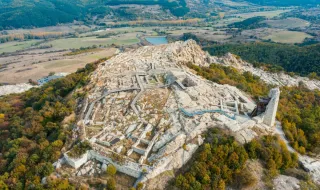
Pergamum or Pergamon is most likely the ancient name of Perperikon, said archaeologist Prof. Nikolay Ovcharov when presenting the results of this year's excavations of the rock city, BTA reports. The hypothesis was expressed by him 20 years ago, but according to the archaeologist, today it is supported both by the scale of the archaeological site and by new studies of ancient geographical maps.
The theory is based on the works of the Roman geographer Claudius Ptolemy, who lived in the 2nd century. The maps created based on his work “Geography“ mark a city with the name Pergamum or Pergamon, located in the Rhodope Mountains. According to Ovcharov, the location roughly coincides with the middle course of the Arda River.
An additional argument is the research of specialists from the Technical University of Berlin, who equate Ptolemy's coordinates with the modern geographical system. The latter study places the ancient Pergamon in the Eastern Rhodopes, between Zlatograd and Kardzhali. Ancient maps allow for a deviation of 20-30 kilometers, but according to the archaeologist, this does not change the main conclusion.
„When we combine archaeological data with historical data and with what has recently been discovered in this direction, we can now categorically say that the old name of Perperikon is Pergamum or Pergamon“, said Prof. Nikolay Ovcharov.
He explained that the name means fortification or fortress and comes from the Hittite-Luvian language, from where it also entered the Thracian language. The existence of another famous ancient Pergamon in Asia Minor does not contradict the hypothesis, since in ancient times different cities bore the same names.
New relics and discoveries
During the closing archaeological season, finds from the Roman era to the 14th century were discovered. Among the most valuable is a bronze encolpion - a reliquary with an image of the Virgin Oranta, dated from the 10th - early 11th century, the time of Tsar Samuil.
The two halves of the reliquary were found with a difference of a month and a half. First, archaeologists discovered the back part, and only days before the end of the excavations - the front half with the image of the Mother of God. The encolpions were used to store holy relics and other Christian relics.
Archaeologists have also discovered a second reliquary from the 11th-12th centuries, which is about to be opened and examined. A votive tablet from the 2nd-3rd century and an image of Zeus with portrait features were found from the Roman era. Among the other finds are fibulae from the 4th-5th century, objects from the late 6th and early 7th centuries, as well as medieval bracelets, appliques and earrings from the 14th century.
According to Ovcharov, the finds confirm that Perperikon was inhabited continuously throughout different historical eras. The archaeologist described the season as extremely successful and pointed out that over the past three years, research has progressed significantly thanks to funding for priority archaeological sites.