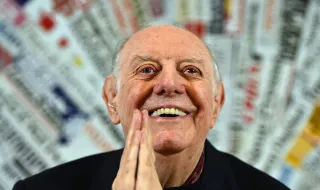
On stage, Dario Fo is often alone. With just his voice, body and imagination, he can turn an actor into a whole crowd, and an old story - into a modern political debate. The Italian playwright, actor, director and composer died on October 13, 2016 in Milan, at the age of 90. In the last months of his life, he had lung problems and was treated in hospital, Italian media reported, quoted by “The Guardian“.
Fo was born in March 1926 in San Giano, on Lake Maggiore. He grew up in a family close to the theater and the resistance to fascism. His father was a railway employee and amateur actor, and his mother was a storyteller with a flair for folk tales. From his grandfather, Fo learned the rhythm of oral storytelling - a skill that he would later turn into a trademark of his stage language.
The one-man show that breaks boundaries
His most emblematic work is “Mystery of the Buff“. First staged in 1969, it brings together biblical plots, medieval legends and folk motifs, but tells them from the perspective of the common man. Fo uses mimicry, exaggerated movements, dialects and grammelot - a stage language of sounds and intonations that resembles different speeches without fully following any of them.
The show became a theatrical phenomenon and has been performed thousands of times. On stage, Fo changes characters, ages and social roles in seconds. Laughter for him is not just entertainment - he overturns hierarchies and allows the audience to see power from its most uncomfortable angle.
Satire against institutions
Fo and the actress Franca Rame, whom he married in 1954, created a joint theater company in 1958. The two staged plays in which politics entered everyday life: in the kitchen, at work, in the police station and in the television studio.
In 1962, their conflict with RAI interrupted their television career for 15 years. The reason was a dispute over satirical sketches and requests for changes to the text. Later, Fo and Rame directed their work towards independent theater spaces and an audience outside traditional cultural institutions.
In “The Accidental Death of an Anarchist“ Fo uses farce to talk about the death of railway worker Giuseppe Pinelli in a police station in Milan. In “We won't pay! We won't pay!“ the economic crisis is transformed into a story about women who rob a supermarket in protest against price increases. Behind the comic situations are themes of police violence, poverty, labor and abuse of power.
The Nobel Prize for a Medieval Jester
In 1997, Fo received the Nobel Prize in Literature. The Nobel Committee defined him as an artist who “following the example of medieval jesters, scourges power and restores the dignity of the wronged“.
The distinction is controversial because Fo is primarily a man of the stage, not an author known for traditional novels or poetry. His answer lies in his work itself: he proves that theatre can be literature, political commentary and a lively conversation with the audience at the same time.
After the death of Franca Rame in 2013, Fo continued to work and write. He remained active almost until the end of his life – with plays, novels, lectures and performances for artists. This is one of his most lasting legacies: for Dario Fo, the stage was never just a place for performance. It was a place from which one could laugh at fear and reclaim the right to ask questions.
Sources: theguardian.com, euronews.com