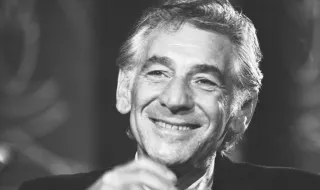
When the phone rang at the home of 25-year-old Leonard Bernstein on November 14, 1943, he was still the assistant conductor of the New York Philharmonic. Bruno Walter was ill and the young musician had to replace him in a concert at “Carnegie Hall“. There was no time for rehearsal with the orchestra, and the performance was broadcast live on national radio. The next day, Bernstein was already known throughout America.
Today, October 14, marks the 36th anniversary of his death. The American composer and conductor died in New York at the age of 72. However, behind his world fame lie a number of lesser-known stories.
From Louis to Leonard
Bernstein was born on August 25, 1918, in Lawrence, Massachusetts, as Louis Bernstein. His family called him Lenny, and at the age of 16 he officially changed his name to Leonard. His father, Samuel, a cosmetics salesman, initially did not believe that music could be a profession. The boy began playing the piano after taking lessons from a neighbor who charged one dollar per hour.
At Harvard, Bernstein did not limit himself to music. He was interested in literature, philosophy and languages, and in 1939 he conducted the music for a student production of “The Birds“ by Aristophanes. This early experience suggested the direction that would later make him unusual in the classical world: the ability to combine complex music with immediate communication.
Maestro between opera, Broadway and television
In 1953, Bernstein became the first American to conduct at Milan's La Scala. Five years later, he was appointed music director of the New York Philharmonic - the first American to hold that position. By 1969, he had conducted 831 concerts as music director, and his total appearances with the orchestra reached 939.
In parallel, he wrote music for the stage. West Side Story, which premiered in 1957, transformed urban conflict, love, and racial tension into a dramatic musical tale. The composer collaborated with lyricist Stephen Sondheim, playwright Arthur Laurents, and choreographer Jerome Robbins.
Bernstein transformed television into a concert hall. Between 1958 and 1972, he conducted 53 editions of the New York Philharmonic's Youth Concerts. In 1962, he received an Emmy Award for his educational work. In 1973, he gave six lectures at Harvard, in which he examined music as a system similar to language.
Music after Tragedy
In 1948, Bernstein conducted a concert in Munich for Holocaust survivors. Years later, after the assassination of John F. Kennedy, he articulated his belief in the role of art:
„This will be our response to violence: to make music more intensely, more beautifully, and more devotedly than ever before.“Bernstein recorded more than 500 compositions, over 450 of them with the New York Philharmonic. He died on October 14, 1990, but left behind not only scores and recordings, but also a model for a musician who refused to choose between opera, Broadway, television and the classical stage.
Sources: latimes.com, apnews.com, time.com