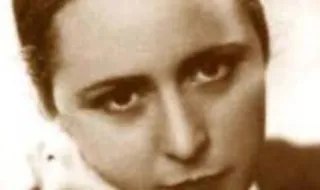
In the community center, library or old home cupboard, her books most often stand next to each other - – “The Thessalonian Miracle Worker“, “Kaloyana's Daughter“, “Ioan Asen II“, “The Boyana Master“. This is what the literary legacy of Fanny Popova-Mutafova looks like - the writer who turned the Bulgarian Middle Ages into a world of rulers, battles, palace intrigues and human choices.
Fanny, whose birth name was Stefanka, was born on October 16, 1902 in Sevlievo. Her father, Dobri Popov, was an officer and teacher at the Military School. Until 1914, the family lived in Turin, where the future writer studied Italian and piano. Later, she graduated from the First Girls' High School in Sofia, and in Munich, she studied piano at the conservatory and attended lectures on art history. She is the wife of the writer and architect Chavdar Mutafov.
Before establishing herself as an author of historical fiction, Popova-Mutafova wrote short stories, novels, essays, and books about women and motherhood. By 1944, she had over 30 books behind her. She was awarded prizes by the Bulgarian Academy of Sciences, and in 1937 she was listed as the first woman to work successfully in the field of historical novels and short stories.
Assenovtsi between history and imagination
The most lasting place in Bulgarian literature is given to her by the novels about the Asenovtsi. „The Miracle Worker of Thessaloniki“, „The Daughter of Kaloyan“ and „Ioan Asen II“ build a large-scale picture of the time of the Asenov dynasty. The novel „The Last Asenovet“, known in subsequent editions as „The Master of Boyana“, was later added to the series.
Popova-Mutafova does not perceive history as a storehouse of dates, but as material for dramatic human destinies. She studies chronicles and historical works, meets with researchers and transforms the facts into a narrative that is both accessible and convincing.
“If there were no hour when the lights in the reading rooms go out, I could wake up at dawn without getting tired of reading, searching, sifting through tones to find some small precious grain“, writes Fani Popova-Mutafova.Her interest in the Middle Ages also extends to the stage. Based on her novel “The Thessalonian Miracle Worker“ Pancho Vladigerov created the opera “Tsar Kaloyan“, and the novel “Kaloyan's Daughter“ became the basis for a ballet.
After the war: sentence and silence
The writer's life changed dramatically after 1944. On April 4, 1945, the People's Court sentenced her to seven years in prison for her journalism and public activities during the war years. She served 11 months and was released early due to severe asthma. Her husband Chavdar Mutafov was also sent to a camp.
After that, her books were taken out of circulation, and Popova-Mutafova worked as an editor and translator from Italian. In 1962, she began publishing again, including revised editions of her earlier works. In the last years of her life, she wrote biographical and historical works, including the novel about Dr. Petar Beron.
Fani Popova-Mutafova died on July 9, 1977 in Sofia. Today, her name is both admired and controversial because of her political positions and fate after the People's Court. But her books continue to bring readers back to the kings, warriors, and statesmen of the Second Bulgarian Kingdom - not as distant names from a textbook, but as heroes of a great novel.
Sources: archives.bnr.bg, bta.bg