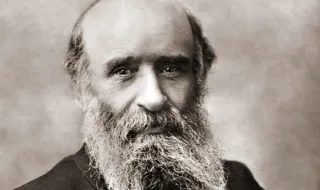
Before there was a state, Bulgaria already needed institutions to preserve its memory. It was at this moment that Marin Drinov appeared - a scientist from Panagyurishte, who turned the study of the Bulgarian past into an independent scientific task.
Marin Stoyanov Drinov was born on October 20, 1838 in Panagyurishte. He received his education at the Kiev Theological Seminary, and later completed his historical and philological education at Moscow University. He worked and collected historical materials in a number of European cities - Vienna, Prague, Paris, Geneva and Rome. In libraries and archives, he searches for documents with which to restore the Bulgarian past not through legends, but through verifiable sources.
The books with which scientific historiography began
In 1869, two of his most significant works were published in Vienna - – “A View on the Origin of the Bulgarian People and the Beginning of Bulgarian History“ and “Historical Review of the Bulgarian Church from Its Very Beginning to the Present“. With them, Drinov focuses on issues that are important not only for science, but also for national self-awareness.
He explores the origin and early history of the Bulgarians, the settlement of the Slavs on the Balkan Peninsula, the development of the Bulgarian Church and the place of medieval writers. He also writes about Paisius of Hilendar, Patriarch Euthymius, and the work of the holy brothers Cyril and Methodius.
„Language is the spiritual fortress of a people.“This thought summarizes one of the leading ideas in his work: that language, education, history, and literature are the foundations on which the modern nation is built.
The Chairman of the Bulgarian Literary Society
On September 30, 1869, old style, or October 12, new style, the Bulgarian Literary Society was founded in Braila. In Drinov's absence, the assembly elected him as the first chairman. The society later became the Bulgarian Academy of Sciences, and Drinov's name remains permanently associated with its beginnings.
After the Liberation, the headquarters of the society was moved to Sofia. Drinov also participated in the establishment of the first cultural and educational institutions of the free Bulgarian state. At the end of 1878, he was among the people associated with the founding of the Sofia Public Library.
From the scientific hall to the building of the state
During the Russo-Turkish War, Drinov was involved in the civil administration of the liberated Bulgarian lands. Then, in 1878-1879, he led public education and spiritual affairs. He worked on issues related to school work, legislation and the organization of the new state.
His name is also associated with the proposal that Sofia be chosen as the capital of Bulgaria. For Drinov, this was old Serdika - a city of historical significance and with the potential to become the center of the restored state.
The last decades of his life were spent mainly in scientific work. Drinov became a professor of Slavic studies at Kharkov University and continued to publish research on Bulgarian history and culture. He died in 1906, but he left behind more than just books. He left behind a model for how a scientist can simultaneously research the past and participate in building the future.
Sources: bta.bg, archives.bnr.bg